Gardner Museum Heist —Blog
|
Close encounters of the weird kind with former members of the Boston Globe Spotlight Team  Reformatted information
from the WatchDog New England Our Staff page,
Reformatted information
from the WatchDog New England Our Staff page,
saved by the Internet Archive on September 25, 2014. I don’t know if I will ever write a screenplay about the strange experience I had in August of 2014, with two former members of the Boston Globe Spotlight Team, but I have the title all picked out. I’m going to call it “Gaslight.” But as I have come to understand, to borrow a Stephen Kurkjian trope, that when it comes to the Gardner heist investigation, gaslight is mostly the only light there is. You either navigate your way through this sometimes blinding, mostly gloomy netherworld, to sift through the wreckage made of reality for a few slender strands of historical fact with which you can pull your way forward, or you can allow yourself to be overwhelmed, and let the liars win. This was not my first close encounter of the weird kind, inside the Gardner heist defactualized zone, the existence of which points to there being more, much more going on with this case than an investigation into just some "burglars, who would have just as easily stolen a car or somebody's TV, and didn't know what they were doing," as is claimed by the FBI's now retired lead investigator on the case, Geoff Kelly. The year 2014 was a singularly meager one for Gardner heist news coverage. There was no mention of it around the time of the anniversary of the historic robbery in the Boston Globe that year, as has been the case for decades, with the exception of that year. The previous year on the 23rd anniversary, the FBI held a nationally covered press conference to update the public about the FBI’s “progress” in the case. It was a dubious justification for the press conference given that there was little information shared with the press and public to support the contention of there having been progress. Richard DesLauriers, the Special Agent in charge (SAIC) of the FBI's Boston office, told the New York Times that FBI was starting a publicity campaign to focus attention on the paintings in the hopes of garnering leads from the public and possibly from acquaintances of the thieves, anyone who may have glimpsed one of the paintings." The biggest news from the press conference that day was the announcement, the unsupported claim really, that the FBI knew who the thieves were, but they were not releasing the names." Only a columnist for a small south of Boston suburban daily newspaper, The Patriot Ledger, however, expressed any skepticism about the press conference in the news media. “I happen to think," Matt Connolly, a retired career prosecutor and former Norfolk County assistant district attorney wrote, "that the FBI is blowing a lot of smoke."In his prepared remarks, DesLauriers announced “We have identified the thieves, who are members of a criminal organization with a base in the mid-Atlantic states and New England." He also said that “The FBI believes with a high degree of confidence that in the years after the theft the art was transported to Connecticut and the Philadelphia region and some of the art was taken to Philadelphia where it was offered for sale by those responsible for the theft." That statement implied the thieves were still alive. But then, when Tom Mashberg of the New York Times asked Agent Kelly that same day if the thieves were dead or alive, Kelly "would not say." At the same time, a retired FBI agent and co-founder of the FBI’s Art Crime Team, Robert Wittman, who worked out of the FBI's Philadelphia field office, when an attempted Gardner art sale was said to have occurred, expressed strong doubt about an attempted sale of Gardner art in Philadelphia. "It was my specialty, and I didn’t have an inkling of it," Wittman told The Boston Herald. Wittman "cautioned that, like the other 'morsels' released yesterday, it may be nothing more than 'camouflage' for the FBI’s true intent." It was not reported which of the other morsels distributed by the FBI that day were deemed comouflage by Wittman, "for the FBI's true intent," or what the FBI's true intent might be.With little to no public activity by the FBI in 2014 to generate interest in the case, Gardner heist news coverage dried up, after a couple of embarrassing end-of-year interviews by Kelly in 2013. The only breaking news story that year about the case in 2014 came on May 21st. After over a decade as the FBI's lead investigator on the case Kelly did what was billed by Fox 25 News (the lowest rated local TV news station in the Boston market) as Kelly's first ever television interview on the Gardner heist case, even though Kelly had sat to answer questions on television TWICE, less than six months earlier, with the BBC and with WGBH in December of 2013 Kelly made headlines in rival local media outlets, for telling Fox 25's Bob Ward that the FBI had confirmed sightings of some of the Gardner stolen paintings from informants. Several local news organizations, including the Boston Globe, and even CNN picked up the Fox 25 News story. Kelly's claim that "there have been sightings of it, confirmed sightings," was perhaps a bit of narrative housekeeping. Four years earlier, in a front page 2010 Boston Globe story, Kurkjian quoted Kelly as saying that “In the last 20 years and the last eight that I’ve had the case, there hasn’t been a concrete sighting, or real proof of life.” Kurkjian repeated this statement by Kelly in his 2015 book, and in numerous subsequent interviews. Only in a front-matter section of Kurkjian's book, called "Cast of Characters," did Kurjian note that Kelly had changed his story and had begun claiming that there were confirmed sightings after all. [Kelly was] "quoted in 2010 as saying there had never been a “concrete sighting” of any of the stolen artwork, but told a Fox TV reporter without providing any details in 2014 that there had been a 'confirmed sighting' of one of the paintings." But the big press conference of 2013, had to have been about something. Kelly's no concrete sightings statement from four years earlier was a loose end that needed to be tied up and then tossed into the Charles River.
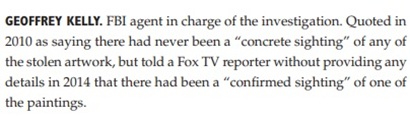 The Boston Globe ran an Associated Press story supplemented with several paragraphs by "Globe staff," of the Fox 25 News interview. Other news outlets, including the Globe, placed "confirmed sightings" right in the headline. The Globe's (AP) online article also included a six-minute video overview of Gardner heist history presented by Stephen Kurkjian, who was uncharacteristically morose in describing the theft and what the robbery means to the city. Kurkjian did not make a single reference to the FBI, efforts to recover the art, or anything about "confirmed sightings" of the art. The Globe article included several additional paragraphs from Boston Globe staff that were not in the original Associated Press story. But the added reporting they supplied, did not reference Kelly's headline garnering statement, which flatly contradicted what Kurkjian reported in the Globe. The story completely ignored the major contradiction between Kelly's recent 2014 claim, of their having been confirmed sightings of the stolen Gardener art, and their own reporting four years earlier. Some of Kelly's 2014 interview can be viewed in a 2020 segment of Boston 25 News. It was recycled into a Gardner heist segment the station did six years later, Forrest Gump style, which serves to underscore the utter lack of progress in the investigation during those six years, despite all of the "tantalizing" reporting by the Boston Globe and other news media. "Fox 25 News" was renamed "Boston 25 News" in 2017, while remaining a Fox affiliate. In that 2014 interview, Ward says that "as federal investigators listened to their informants and wiretaps, they [the FBI] heard Merlino talk about trying to return two of the stolen [Gardner] pieces." Then Kelly said: "Unfortunately it fell through but by the tenor of what he was saying, we deemed it to be credible," Kelly said.But when some of the wiretaps of TRC Auto Electric were included in the Netflix documentary This Is A Robbery Episode 4, in 2021, such as "The Bikfidz Tape," there was nothing on any of the recorded made public at that time related to the Gardner heist and Kelly made no mention of having recordings of Merlino discussing the Gardner art in his 2026 book. In the 2014 Fox 25 News interview, Kelly claimed that a planned return of some stolen Gardner art by Carmello Merlino was short-circuited by his arrest in the Loomis Fargo armored car depot robbery attempt, Kelly claimed in 2014. In fact, the robbery was a set up by the FBI, with the assistance of an informant, an ex-con, Anthony Romano, who Merlino knew from prison, and who worked for him at his place of business, TRC Auto Electric. Bob Ward Fox 25 News: "But before any negotiations started [transcript], Merlino and members of his crew were busted in Boston on their way to rob the Loomis Fargo armored car depot in Easton. And that killed the deal for 'The Storm on the Sea of Galilee.'"Geoff Kelly: "Well yeah, it certainly did, Kelly stated. and their defense was that this whole thing was entrapment set up by the FBI to get them to cooperate about the Gardner Museum [robbery]." It was a patently false claim, one Kelly repeats in his 2026 book on the Gardner heist, "13 Perfect Fugitives." Although one of the would-be robbers, David Turner, attempted to have his conviction overturned on the grounds of "entrapment," his appeal was rejected. The court ruled that his prior convictions established that "he was predisposed to commit the instant offense" So while it didn't meet the legal standard of "entrapment" for that reason, Turner had in fact been caught in an FBI sting. This was not a matter of dispute by the prosecution, the defense or the judges. A 2007 ruling by the First Circuit Appellate Court, affirming David Turner's conviction in the robbery noted that: "In addition to the tapes and physical evidence, the government presented the testimony of Romano, Nadolski, and a host of other [FBI] agents who had participated in the sting." The court used the term "sting" five times in their ruling, and one at point stated plainly: "The planned heist was an FBI sting..." If Merlino was going to help get the art back of his own free will, the FBI would not have set him up with a "sting."In a March 18, 2026 article in the New York, on the same day Mashberg appeared at a bookstore in Boston to promote Kelly's book, in an article about the just release work, wrote: "What is clear, Kelly writes, is that in the 1990s Merlino told the F.B.I. that, while he did not have the art, he may know someone who did. Investigators promised Merlino immunity if he could produce any of the paintings. But he later became uncooperative and negotiations fizzled out," This is completely made up. Kelly does not say anything like this in his book. While not using the word "sting" he described in detail that it was. He wrote: "Loomis Fargo’s newest employee wasn’t a gambling fucking degenerate' at all; in reality, he was an FBI agent named Dave Donahue," in describing the FBI undercover agent in place at Loomis Fargo, part of the trap they had set for Merlino, Turner and the other robbers. 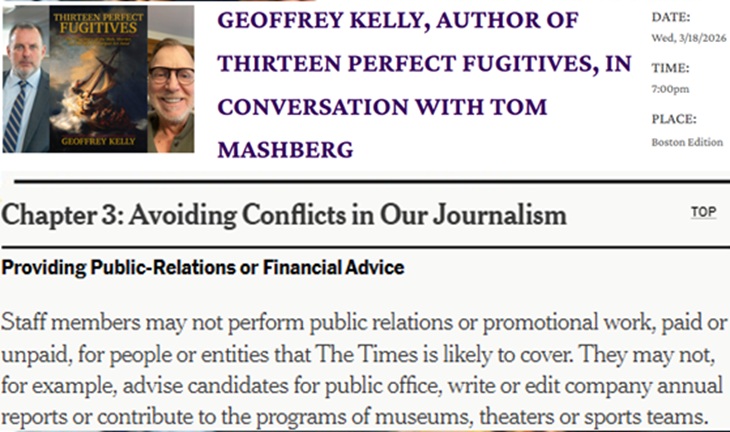 Tom Mashberg makes a personal
appearance with Kelly to promote
Tom Mashberg makes a personal
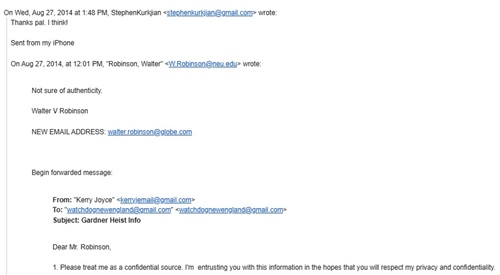
appearance with Kelly to promote his book "13 Perfect Fugitives" on the same day his story about the book ran in the New York Times in violation of the Times' Ethical Journalism Handbook There is nothing in Kelly's book about Merlino becoming uncooperative, or about the negotiations fizzling out. Unlike in his 2014 interview, in his book, Kelly does not relate the two schemes, (that of returning the stolen Gardner art, and robbing the Loomis Armored car depot), at all, except that they were happening around the same time, 1997-1998. They appealed their convictions on a number of grounds," he wrote, "The issue of entrapment was dismissed..." "As Judge Stearns unequivocally stated, Kelly continued, 'Let me stress, however, that I agree that the fact that the government creates a crime is insufficient ‘without a lot more’ to make out a due process [entrapment] violation.'” Turner also claimed that he was set up to force him into telling what he knew about the Gardner heist. He made a pretty persuasive case that he did not know anything by serving twenty years in prison. But Kelly doesn't get into that issue either. Kurkjian, an attorney and the "lead reporter for more than a decade on the Gardner Museum art heist," who was writing the final chapter of a on the case at that time, would have known the real story of Merlino's arrest and conviction for the Loomis Armored car depot robbery attempt. He had to know that Kelly was lying. Like Kelly, U.S. presidents might have a stable of surrogates in the media, who could be counted on to support their more questionable claims. But there was always the inevitable partisan pushback from their rivals for political power. With the FBI's communications on the Gardner heist, there was no pushback or challenge from the media. Kelly could say whatever he wanted, about the Gardner heist investigation as he demonstrated in his Fox 25 News interview in May of 2014. There would be no challenge from either the mainstream nor MAGA media.The Patriot Ledger's Matt Connolly, a war veteran, former Marine Lieutenant, and career prosecutor, stood up to Kelly and the FBI, in a column he wrote, which ran two days after his Fox 25 News interview. Accusing Kelly of perpetuating "a hoax on the public," Connolly wrote, "Agent Kelly has been on the case for many [at that point 12] years; it’s time the FBI put someone else on it to give it a fresh look."Kelly would serve as the lead investigator on the case for another 10 years, twenty two years in all. It was a tenure, Kelly himself said, was unprecedented, to the best of his knowledge in the history of the FBI. If the Bureau wanted anything else from him and were not getting it, they could have replaced him with someone else with little fanfare. Not only had he kept the case for a long time, he also took the case with him when he changed FBI field offices, which is also highly unusual, Kelly said. It was likely that Connolly earned little, as a columnist for the Patriot Ledger. He posted his columns on his own website too, originally named The Trial of Whitey Bulger, and after the trial ended, he renamed it Trekking Toward The Truth. Not one given to hyperbole or extremism, Connolly had a long and successful professional life, with an independence journalists and columnists typically lack. Connolly's assertions about the FBI's Gardner investigation left little middle ground. On his website he described the FBI's claims in their press conference as "its silly story." The public face of the Gardner heist investigation was either "a hoax" as Connolly had asserted, or it was, what the FBI said it was, the pursuit of art stolen by "members of a criminal organization with a base in the Mid-Atlantic states and New England,” which aside from monumental size of their haul, was an ordinary robbery by ordinary bad guys looking to make a fast, criminal buck, "the handiwork of a bumbling confederation of Boston gangsters and out-of-state Mafia middlemen, many now long dead." Three months after Kelly's interview on Fox 25 News, owing to the actions of some of the people close to the investigation, or at least the public face of it, which I had the opportunity to observe, after sending an email to Northeastern's Watchdog New England, I began to suspect that Connolly was right. Kelly and the FBI were perpetuating a hoax on the public, and the fourth estate, the news media, was in some cases helping them do it, while in most cases staying silent. I contacted Watchdog New England, as just a concerned citizen with no direct personal knowledge of the Gardner heist case, without any government, law enforcement, media, or criminal underworld affiliations; a guy with a wife and a couple of school-age kids, who perhaps saw something, said something and asked for nothing in return then or ever, except one thing: to be treated as "a confidential source," and I didn't get it. I sent my email around 11:30 in the morning of August 28th, 2014. It was addressed to Walter Robinson the Boston Globe editor, and former Globe Spotlight Team head, who at that time was a Distinguished Professor of Journalism at Northeastern University, and the head of Watchdog New England, (It's actual, formal name was: the "Initiative for Investigative Reporting at Northeastern University")“The ultimate goal of this initiative was to make it possible for smaller community news organizations–which do not have substantial resources–to do serious watchdog and investigative reporting,” Robinson told the Columbia Journalism Review in 2011. The accelerating pace of information technology likely rendered the Watchdog New England mission obsolete. It was no longer taking substantial resources to do "serious watchdog and investigative reporting." What it did take was the willingness, the gumption, and the determination to do it, and those human resources were lacking at WatchDog New England, and everywhere. Robinson had famously led the Globe Spotlight Team during its coverage of the Roman Catholic clergy sexual abuse scandal. Kurkjian was also a Spotlight Team member during that time, and the two former colleagues, along with other Spotlight Team members won a 2003 Pulitzer Prize for public service, for their coverage of the scandal. The impact of the series was felt throughout the country and the world. I did associate Robinson's name with the Boston Globe but my interest in sharing information with him had to do with his current position with Watchdog New England, not his past associations with the Boston Globe. My email to Robinson began as follows: "Dear Mr. Robinson,1. Please treat me as a confidential source. I'm entrusting you with this information in the hopes that you will respect my privacy and confidentiality." What followed was about 13 pages of information about three possible culprits in the Gardner heist case. Robinson quickly forwarded my email, 30 minutes later, to his former colleague at the Boston Globe as well at Watchdog New England, Stephen Kurkjian, who had left the organization the previous year, The body of Robinson's email to Kurkjian began and ended: Robinson was one and done. He never replied to my email, or subsequent follow-up emails, or acknowledged receipt of it to me in any way. He had forwarded my email over to "the expert," a trusted (by him) former colleague. Butt covered.In contacting me that same day, Kurkjian began: "Dear Kerry: Mr. Robinson (Robby) passed on your email that you'd sent to him." He included (forwarded) my email to Robinson; as proof, I guess. Why did Kurkjian assume that Robinson had not informed me of this himself? Was this standard operating procedure for how they take care of the little guy, as Kurkjian claimed to do? Or was this particular little guy (me) being treated differently because I was reaching out about the Gardner heist in a potentially problematic way? 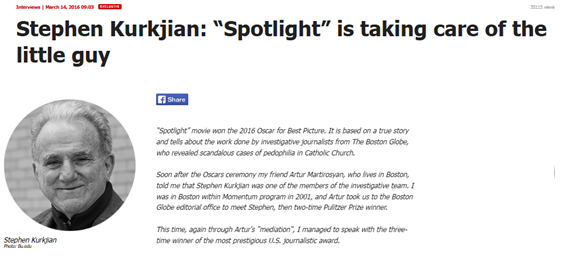
"Taking care of the little guy," if by little guy you mean the FBI, the Boston Globe, WBUR, and the Gardner Museum I believe that what would have been the professional, and courteous, the decent way for Robinson to handle my correspondence, given my request for him "to treat me as a confidential source," would have been for him to include me in the decision to forward my email to Kurkjian, or at the very least to inform me of what he was doing it, or maybe to just reply to my email, or one of my subsequent emails, or something.
 Portion of an email sent to me by Stephen Kurkjian
 On March 4, of 2026, I sent an email to a Boston Globe reporter, Amanda Milkovitz, about a new $2530 annual fee, not covered by insurance, that my primary care physician was about to begin charging all of his patients, if they wished to stay with his practice. He was affiliating with an outfit called MDVIP, which "supports affiliated physicians in delivering personalized, preventive care." At that moment, Milkovits was the Globe reporter covering a closely watched and "contentious grandparents visitation rights trial in the Kent County [Rhode Island] family court." Milkovitz, who was in the courtroom, had a story in that day's newspaper based on her coverage of the courtroom testimony from the day before as well as another story about additional trial testimony in the Boston Globe the following day. I think it is fair to say Milkovits was as busy as any other Boston Globe reporter on the day and at the time I contacted her. I had not asked to be a confidential source as I had done with Robinson, nor had I asked for any special treatment or consideration in any way. Yet, Milkovits managed to reply to me the same day: "Hello Kerry, Thank you for your email. I'm unfortunately tied up, but I've forwarded your email to my editors, so they can look at your concerns." Pretty standard stuff, except when the topic is the Gardner heist or maybe some other off-limits subject areas, apparently. Kurkjian, one of the original members of the Boston Globe Spotlight Team, had been the Globe's Washington Bureau Chief from 1986-1991, at the time of the Gardner heist. His own reporting had most notably focused on a personal scandal involving Congressman Barney Frank, a leading liberal voice in the U.S. House of Representatives at that time. Frank survived the scandal, and went on to be one of the principal authors of the Wall Street reform legislation, Dodd-Frank, enacted in the wake of the 2008 financial crisis. Far from the scene of the crime, Kurkjian was nonetheless close to the scene (Washington DC) where the Gardner heist investigation was being run. He did report somewhat local stories on occasion, like one in in August of 1989 (eight months before the Gardner heist) called "Restraining the media at the CIA" about a talk given at Harvard University, by William M. Baker, a former public information officer for the then head of the CIA William H. Webster. Baker's lecture concerned the brave new world of horse trading between journalists and the intelligence community. "On one occasion, Baker asked a reporter to withhold publication, and in return offered to give the reporter the entire story once an arrest was made. 'Obviously, this assurance of a scoop was a critical factor in his -- and his editors' -- response,' Baker said in explaining why the [New York] Times decided to hold the story."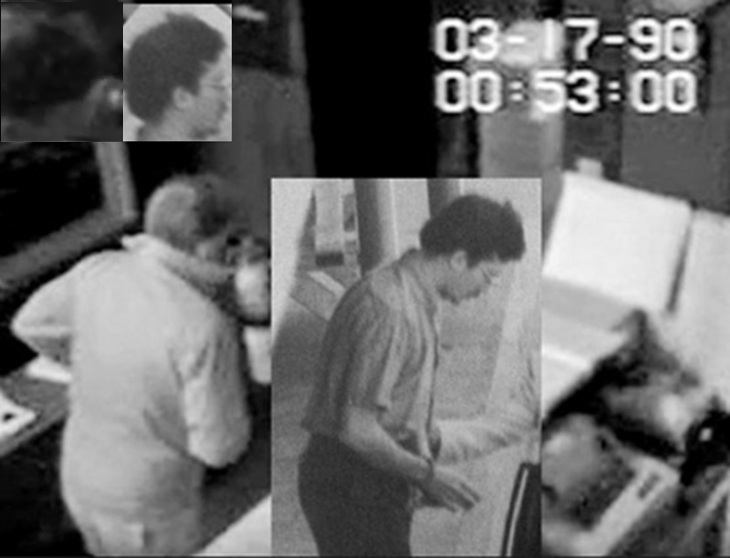
Pictures of Gardner heist eve video visitor March 17, 1990 (left) and Rod Ramsay in Tampa, FL after his arrest on espionage charges on June 7, 1990 (right) In the case of the Gardner heist, the "entire story," which a well liked journalist might look forward to receiving would be recovery of the Gardner art, which the FBI in their 2013 press conference implied was imminent. It was also quite possible that the FBI was only withholding the names of the thieves, temporarily. That was another potential entire story that could be shared with some deserving journalist at some point. It would be hard to keep the names of mere robbers secret, especially if they were dead, unless the names were classified because one or more of the thieves were not mere robbers.
"We assess that Saudi Arabia's Crown Prince Muhammad bin Salman approved an operation in Istanbul to capture or kill Saudi journalist Jamal Khashoggi," the report by the office of the US director of national intelligence says," the BBC reported, in February of 2021. So the United States government could accuse one of the richest and most powerful heads of state in the world of butchering a Washington Post columnist, but could not reveal the names of the “bumbling confederation of Boston gangsters and out-of-state Mafia middlemen,” who robbed the Gardner Museum, and nobody challenges it. That was the free press America had before Trump’s second term. The levers of autocracy were already there. Trump was merely the first one to really take them for a test drive. In any case, the FBI was claiming to have information, the names of the thieves that every reporter present was vitally interested in having, and not getting...yet. "With today's announcement we begin the final chapter," DesLauriers stated in the FBI's press conference. Six months later, Anthony Amore told a packed room, which included about a 100 senior citizens at the Milton Public library, that the stolen Gardner art would be returned in their lifetimes. In 2025, Amore assured the two most helpful reporters in disseminating the FBI's Gardner heist narrative, that they would be his first call if there when he recovers the Gardner art. "You and Shelley Murphy both say the same thing to me all the time. 'Hey, I'm going to be your first call, aren't I?' and you would be because the both of you are the best crime reporters in the city without a doubt." But starting in 2023, the FBI was not making promises they were making excuses. Geoff Kelly was prepping for his post-retirement 2026 book on the case. "We're really looking for, what I call 13 perfect fugitives," (the title of his 2026 book) Kelly said in an official FBI podcast. Because they are the perfect fugitives. They don't get sick. They don't have to go to the dentist with a tooth ache. They don't have to get a driver's license."The FBI had gone from "we begin the final chapter," to saying ten years later, final chapters are harrrrrd, when they involve finding missing stolen art, (suckers). When Kurkjian retired after almost 40 years with the Globe in 2007, he continued on as a freelance contributor, writing mostly about the Gardner heist. Less than two hours after I had emailed Robinson, Kurkjian, who shared the emails referenced here with me, wrote back to Robinson: "Thanks pal. I think!" Kurkjian’s response, it is fair to say, suggests some ambivalence about his having received the information I shared with Robinson. Is this the spirit of inquiry that investigative journalists generally bring to their job? Apparently, when the inquiry has to do with the Gardner heist it is. You have one Pulitzer Prize winning journalist, who can't forward my email along fast enough, over to another Pulitzer prize winning journalist who seems a bit put out at having received it, but wanted to interview me that very night.At least Kurkjian's pointed reply to Robinson could have offered me a little advance notice that his spirit of inquiry about the Gardner heist case would not necessarily include my efforts, but I did not notice his reply until days later, maybe longer. The Gardner heist is a historic story with a significant level of public interest. When the media-watch program, Beat The Press celebrated its 20th anniversary in 2018, with a review of a half dozen "Media Triumphs" of the top stories during the time of the show's first twenty years, they included a short segment on the Gardner heist investigation. Unlike the other five stories mentioned, the Gardner robbery took place eight years before the first episode of Beat The Press. It seemed like a gratuitous plug. Brief as it was, it still seemed out of place alongside the other big stories: the Whitey Bulger capture, the clergy abuse scandal, the 911 Terrorist attack, the Boston Marathon Bombing, and the Red Sox first World Series win in 86 years. Nonetheless it illustrated that the Gardner heist remained a big story, and showed how it persisted in news coverage. While brief, it still seemed out of place alongside the other big stories: the Whitey Bulger capture, the clergy abuse scandal, the 911 Terrorist attack, the Boston Marathon Bombing, and the Red Sox first World Series win in 86 years. Nonetheless it illustrates that the Gardner heist remained a big story, and how it has persisted in news coverage.There is little reason to think Walter Robinson, of WatchDog New England had achieved the kind of professional success he has earned, and the high esteem of his colleagues, by treating potential sources in the way I was treated by him. It does, however, represent one more example of the strangeness on the part of journalists, when the subject is the Gardner heist and its investigation. If Robinson's response to me was an outlier, then perhaps it was because the Gardner heist investigation itself is also an outlier. As Kelly Geoff Kelly wrote in his 2026 book on the case, "The Gardner case followed none of the conventions and protocols of a typical investigation." Of the length of time he had been assigned to the case, he described it as "bizarre. I don't know of anybody that's had a case that's even close for that length of time." The same could be said of the protocols followed in Gardner heist investigation coverage. In 2019, at a Brown University ACLU panel discussion ("What Press? Whose Truth?"), long time New York Times journalist C. J. Chivers said that 30 years ago, the Times would limit reporters to a maximum term of seven years on any particular "beat," to help ensure the independence and objectivity of the newspaper’s coverage. That has certainly changed in the case of the Gardner heist: Now at the New York Times, Tom Mashberg has been covering the Gardner heist for 30 years, Shelley Murphy for 33 years, at the Globe, Bob Ward, now at Fox 25 News 36 years, and Stephen Kurkjian with the Boston Globe 24 years, until his retirement in 2021. News organizations are no longer willing to sacrifice a congenial relationship with a valuable source, authority or institution on the altar of objectivity.Although not fully vetted at that time, my information represented a strong break, a challenge to the official narrative the FBI was promoting, and seemingly, that was not something Robinson was interested in being a part of in any way. Surely Robinson was aware of some of the doubts news reporters covering the 2013 press conference were having privately, which Kurkjian who was associated with Watchdog New England at the time of the press conference wrote about in his book: There was a "troubling lack of details," from the perspective of "the handful of reporters who had followed the Gardner case closely over the years," Kukrkjian wrote in "Master Thieves" At the press conference the FBI had "sketched out a scenario in the vaguest of terms," he also suggested, and that the FBI’s theory of this crime had "a number of holes in it."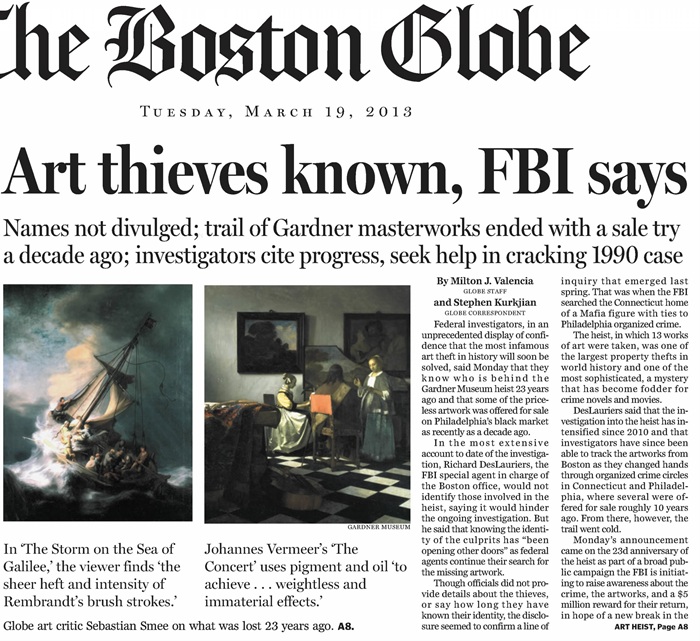
Before contacting Watchdog New England, I had already been through what would turn out to be a similar rigamarole with Anthony Amore, the security director at the Gardner Museum, the previous year. He had exchanged emails with me for ten weeks in 2013, as he worked to get as much information out of me while at the same time, not endorsing the conclusions I had drawn, it seemed, except through his continued willingness to engage with me by email. At one point, he said that he was going to take a newspaper article style write-up I had done about the case, about Rod Ramsay's possible involvement, and why that scenario would be problematic for the FBI. to one of the federal prosecutors working the case, Brian T. Kelly, whom Amore described as a friend. I never heard back about Kelly's thoughts about it, or Amore’s. Brian T. Kelly left the U.S. Attorney’s Office ten weeks later to go into private practice with Nixon & Peabody.Three years after leaving the DOJ, Brian T. Kelly told the Boston Globe “he remains hopeful the masterpieces will be recovered. ‘All it takes is a new lead that leads in a new direction and a lucky break or two,’ Kelly said.” A new direction was what was sorely lacking, a new direction was what I was offering. Robinson wanted no part of it or me. In the absence of FBI backing, it would perhaps be difficult for a media outlet to report that convicted spy Rod Ramsay should be a suspect, based solely on the information I had collected up to that point. I accepted that. But it could have been an incentive for the media to investigate further, and follow up more closely with the claims made by an investigating network, like Watchdog New England. I provided specific steps for doing so in my correspondence. Unless it was quickly disproven, my analysis could also be an opportunity for the media to reconsider the role it had assumed in their coverage, of taking whatever the FBI was saying at face value, and in the case of the Boston Globe and others, in the years since, going above and beyond to support the FBI's disinformation effort, by rewriting the history in a way that gave the FBI's narrative over time a consistency that it obviously and awkwardly lacks. The Boston Globe could have openly expressed some skepticism about the FBI's ever shifting claims, or at least point out the lack of consistency in what the FBI was telling the public. They could question FBI investigators and their surrogates more stringently and begin to ask for some kind of corroboration of some of the FBI’s more dubious unsupported assertions. Instead the opposite has occurred. If the FBI was a friend in need, there were numerous journalists who were willing to serve in the capacity of friend indeed: Bob Ward, Shelley Murphy Kelly Horan Howie Carr, Stephen Kurkjian, and Tom Mashberg, and very few, in fact none locally, except the Patriot Ledger columnist, Matt Connolly, were willing to push back against the FBI’s tide of questionable claims.In the Fall of 2013, Kelly did an interview in the Boston Public Gardens, with Alastair Sooke of the BBC, which aired in December of that year: Sooke: To say things like we're closer than we've ever been and the case is solved sounds like madness if you don't know where the paintings are now and you don't know where they've been for twelve years. Kelly: Absolutely but it's the ultimate whodunit. Sooke: Not the least of which because it's the ultimate whodunit, but according to you, you know who did it, but it's still not solved. Kelly: Well whodunit sounds better than where-is-it [ba-dum bump].
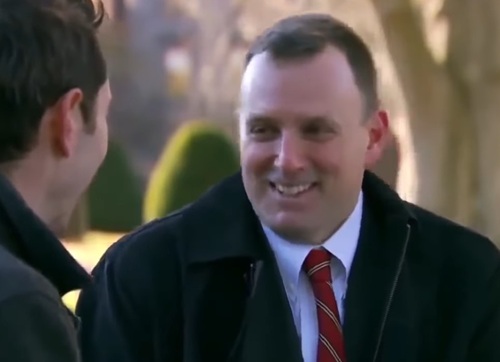 Geoff Kelly laughing at his own joke in a BBC interview in the BBC documentary "The World's Most Expensive Stolen Paintings"
 A month after my interview with Kurkjian, the filming of the movie, Spotlight, about The Boston Globe's Spotlight team of investigative journalists, who reported on the clergy sexual abuse scandal in the Catholic church, began at Fenway Park, in Boston, which is owned by the billionaire owners of the Boston Globe, who also own the Boston Red Sox.
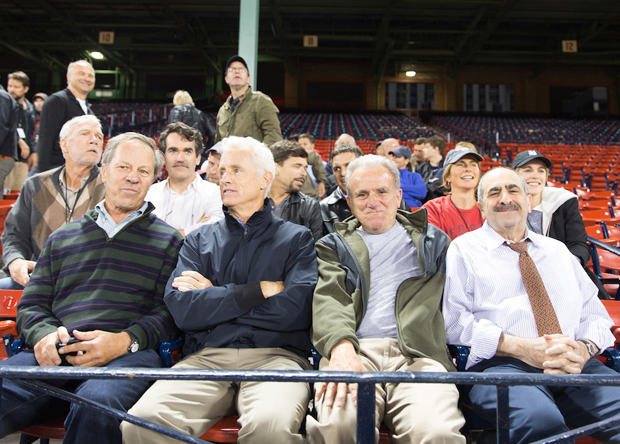
The journalists and actors during the shooting of “Spotlight.” Front row: Ben Bradlee Jr., John Slattery, Steve Kurkjian, Gene Amoroso. Back row: Walter Robinson, Brian d’Arcy James, Michael Rezendes, Mark Ruffalo, Sacha Pfeiffer, Rachel McAdams. The film starred Michael Keaton ("Batman" 1989) as Robinson and Gene Amoroso as Kurkjian. A year later, around the time when the movie premiered at the Venice Film festival, Robinson introduced Kurkjian, who was giving a lecture, and discussing his book about the Gardner heist case on October 7, 2015 at the public library in Plymouth, MA, Kurkjian’s hometown. In one passage of his book Kurkjian writes that, "Hardly master thieves," the intruders pulled the majestic Rembrandt from where it hung on the far wall of the gallery and threw it to the marbled floor, shattering the glass in the huge frame," in his title-be-damned book, Master Thieves. But Robinson was sure enough at least, and even endorsed the authenticity of Kurkjian's book "Master Thieves," which, according to its author, was not about master thieves. To the saying “Don’t judge a book by its cover,” should perhaps be added, or by its support by ex-colleagues of the author, like Walter Robinson. When "Master Thieves" first came out in February of 2015, Kurkjian said in an interview that “Over 25 years, so many names have been thrown into this. I had to come up with an overview that worked and conveyed – even if it wasn’t absolutely true – the latest and best idea of who was involved and how they did it.” The Gardner heist case, with all of its sensationalist baggage, seems to have demanded a new genre of writing, one that is neither fiction nor nonfiction. Thanks to the Garnder heist, what with all of the "names thrown into it: by the investigators, there would in the future be written works that are nonfiction-ish, books, like "Master Thieves." Works that are categorized as nonfiction, but are acknowledged to not be conventionally true in the minds of their own authors. The Dorchester Reporter article was headlined, "Veteran reporter stays on scent of the Gardner heist." Those "so many names," in Kurkjian's book, did not include convicted spy and admitted bank robber Rod Ramsay, a Boston native, whom my research suggested could be involved. Nor did it include the other individuals I had mentioned. If I was correct, Kurkian was staying on a scent, of something, but barking up the wrong tree, albeit one with bushels of government supplied low hanging fruit. As one of the Gardner heist perpetrators Rick Abath observed in his uncompleted barely started book on the case: "It's easy for a reporter to get hooked on to one train of thought and ride it to its logical conclusion; even if it was a fantasy from the beginning." Neither did Kurkjian's book include the name of Brian McDevitt, a Boston area native, from Swampscott, who resided just three miles from the Gardner Museum, at 69 Hancock Street, in Boston's Beacon Hill, when the Gardner heist occurred. It was at a time when the FBI was seemingly looking everywhere, except locally, for the thieves. In the months following the heist, the FBI's official narrative about their hunt for the thieves could be summed up as, "They’re not around here:" Two months after the Gardner heist, a May 14, 1990 front page story headlined: "FBI Said To Have Suspects Worldwide In Gardner Theft” in the Boston Globe began: "The FBI's investigation into the $200 million art heist at the Isabella Stewart Gardner Museum has targeted about a dozen suspects scattered across the world, sources said yesterday." "Investigators are keeping a close eye on the suspects' movements, particularly if they travel in and out of Boston. Sources were divided as to whether any of the suspects were currently in Massachusetts, noting that they frequently traveled from city to city." A “close eye”? Why were they not questioning these suspects? Two plus years later, in 1992, Brian McDevitt did a television interview on the top rated national news magazine program Sixty Minutes about his possible role in the heist. Denying any role, he acknowledged on camera that he had spent the night alone at his home, just a few miles from the museum, and that he had no alibi. In 1993, McDevitt was brought before a grand jury about his possible knowledge of the Gardner heist case. But by that time the 1990 Boston resident was no longer local. He had moved to California. In McDevitt's attempt to rob the Hyde Collection in Glen Falls, NY in 1980, a female delivery van driver went to pick up a package but was "confronted by a man with a gun who forced her back into the van," forced to drive a short distance. She was then "handcuffed, her mouth and eyes were taped, and she was knocked out by an ether-soaked rag." By the time the FBI began serving up their official narrative, about local toughs being the culprits, McDevitt had left the city, left the state, left the country, and was no longer alive. He died in Medellin, Colombia in 2004. To the Boston Globe, McDevitt was no longer the Boston resident, who was at home, just three miles from the Gardner Museum, an ex-con, without an alibi on the night of the heist, a local thug capable of planning and carrying out violence against perfect strangers purely for monetary gain to fulfill his grandiose schemes. Instead, McDevitt was a Hollywood screenplay writer, usually not even mentioned by name in news stories in the Boston Globe. In fact, McDevitt was no more a Hollywood screenwriter and never had been, than he was Paul Stirling Vanderbilt, a scion of one of America's most famous families of the American gilded age, a person whom McDevitt made up and pretended to be, as part of his plan to rob the Glen Falls art museum, the Hyde Collection, in 1980. McDevitt was a thug, but not the kind of thug who quite fit the FBI's and Kurkjian's narratives. He was the kind of thug who was a college graduate, an aspiring preppie, who favored imported Egyptian cotton shirts from Brooks Brothers. Morley Safer on 60 Minutes November 29, 1992: (Voiceover) "McDevitt is now 32, living in Hollywood, where he says he went to reinvent himself, a new, clean McDevitt who would launch himself in a literary career or at least become a screenwriter." So he was going to reinvent himself perhaps as "a screenwriter. From the way Safer put it, the “screenwriter” job sounds like more of a backplan, in case the whole being the next Ernest Hemingway didn’t pan out. And at the time of the Gardner heist McDevitt was even less of a screenwriter, if that’s even possible. Morley Safer: Have you ever published anything anywhere?Brian McDevitt: Nope, haven't. The man that Shelley Murphy at the Boston Globe has been calling a "California screen writer," for over 30 years was neither, nor had he ever been.
Less than two hours after Kurkjian's reply to Robinson, about my correspondence, Kurkjian emailed me: "Mr. Robinson (Robby) passed on your email that you'd sent to him. I worked for him at the Northeastern Initiative [Watchdog New England] and I am pursuing a book on the Gardner theft. I've read your message here, and had some questions. You able to talk about some of the details later today, maybe around 7:30 tonight or tomorrow night?" That email was the most normal and professional thing about my engagements with Kurkjian and Robinson. Kurkjian and I spoke at 8 o'clock that night, just nine hours after my email to Walter Robinson. What I had sent Robinson was a five thousand word document with 38 links to mainstream news sources, including the the New York Times, the Boston Globe, The Economist, and the Orlando Sentinel, as well as links to some primary source documents, which were available online, and in the public domain. My emailed document included several pictures of two of the three individuals, who were mentioned in the document, alongside the Gardner heist police sketches for comparison. My report also included two pages worth of specific suggestions on investigative areas that a reporter could look into to determine if the individuals I mentioned were indeed involved. In my email, I made no claim to having any direct knowledge of the Gardner heist, or of ever having had any personal contact of any kind, with any of the three people I discussed in my document. I had no information about these individuals that was not taken from mainstream media news stories, and primary source documents I found online, with the exception of information about them, and their alleged involvement in criminal activity, that had been shared with me several years before the Gardner heist had occurred. My germ of an idea, my hypothesis, originated with that information. And yet despite the modesty of my claims, Robinson was claiming to not be sure of the "authenticity," of my email as if I was purporting it to be the Shroud of Turin. Maybe Robinson was just speaking casually. If he had included me in the conversation, I could have explained to him why it was not, in my view, anything to be casual about, due to personal safety concerns. My information was possibly authentic enough that he forwarded it to Kurkjian. It was authentic enough that it gained the attention of two Pulitzer Prize winning journalists, one of whom, had written dozens of stories about the Gardner heist going back 17 years at that point, and who wanted to interview me that very night, a person whom neither of them knew or had ever heard of before, an individual who had no affiliation with the government, the media, law enforcement, or criminal gangs, and an individual who claimed no direct knowledge of the case. I was open to sharing this information in further detail with Kurkjian since he had the institutional backing from the Boston Globe to handle whatever challenges that investigating the story might entail. I was not looking for a byline, payment, or credit of any kind. But I also had no intention of just dropping my efforts, if Kurkjian was not interested, unless there was a solid reason for doing so. Writing 12 years later, I continue to have two problems with Kurkjian's initial emails to me, in setting up the interview. I have myself conducted a few interviews in my life, some with famous people, like "Weird Al" Yankovic and Bill Maher, for local entertainment 'zines, as well as with Mitt Romney briefly for the Worcester Telegram and Gazette, when he first ran for the U.S. Senate against Ted Kennedy in 1994. My first problem with Kurkjian was his informing me that he no longer worked with Robinson. Although Michael Keaton, and Gene Amoroso would light up the screen, playing Robinson and Kurkjian, two years later, in the 2016 (Best Picture) Academy Award winning film Spotlight, as far as I was concerned Kurkjian was Robinson's former colleague, not a current one. He was a guy Robinson used to work with, whom he had forwarded my confidential information to, without informing me of doing so. If he respected the material enough to share it with Kurkjian, he should have respected my concerns enough to let me know he was sharing it with him. My expectation was that if Robinson shared my information with anyone, someone not formally affiliated with Watchdog New England, such as a freelance writer for the Boston Globe he used to work with, like Kurkjian, that he would ask my permission. That was the kind of consideration I expected when I prefaced my email with a request to be treated as "a confidential source." But he didn’t even let me know he was doing it. Did Robinson think I didn't know who Kurkjian was? The document I sent specifically referenced a "Special Report," about the Gardner heist case written solely by Kurkjian, and I quoted from it. Why would I contact Watchdog New England if I thought I could get satisfaction from Kurkjian or the Boston Globe? What if Kurkjian had decided not to follow up with me after Robinson forwarded my email, and I had then decided to start trying to contact Kurkjian, not knowing that he had already received the material I had sent to Watchdog New England and he had passed on it? I never heard from Robinson. My subsequent follow-up emails to him were ignored. Had I not heard from Kurkjian either, I would not even have known that he had received my email. Is this how one of the most famous investigative reporters in the world treats people who contact him, concerning what is possibly significant information about a historic news story? A story he thought may warrant further looking into by a fellow investigative reporter, a three-time Pulitzer Prize winner who had been covering the story for over a decade? Perhaps this is how Robinson generally treats potential sources, but his long and storied career suggests otherwise. Given all of the other strangeness about the Gardner heist investigation, and the news coverage of it, I believe there is something different, something peculiar about the Gardner heist and its investigation that makes even storied journalists behave in disappointingly unexpected ways. Most of the Boston Globe articles written by Kurkjian available online at that time included a Boston Globe email address for him, but it was a deactivated account. Still, he was a public person, I could probably find a way to get in contact with him. It likely would have taken an hour or two at that time, and I had considered doing just that after I tried to email him, at one point, and the email bounced back as undeliverable. In the years that followed Kurkjian would write numerous editorials, including in the Boston Globe, claiming that there were people, who were holding back what they knew. But Kurkjian, who claimed to be the Globe's "lead reporter" on the case at that time, could not even be bothered including an email on his stories that was not broken, so that people could share what they knew with him. During a lecture Kurkjian gave on the case at the Foxboro public library in 2017, I pointed out that there was an open pocket knife behind Abath in the crime scene photo he had of him in his slideshow. Kurkjian looked, his shoulders jumped up toward his ears, and he then said it would have to wait for another time. In none of the subsequent lectures that Kurkjian has done, however, or in any of the documentaries he has been involved with, has the knife behind Abath in the crime scene photos ever been addressed.  Gardner heist basement crime scene photo of Rick Abath with an open pocket knife behind him
 In any case, the way Robinson treated me was not Kurkjian's fault, so I wasn't happy with the situation but it did not put me off about speaking with him. The other problem I would come to have with Kurkjian's emailed introduction and proposal to me was his statement: "I am pursuing a book on the Gardner theft." "Pursuing," to me suggested Kurkjian was in the early stages of writing a book, that he was at least still gathering information and that the book was still taking shape. But in fact, Kurkjian had already completed his book, by the time I spoke with him. It was available for sale just six months after his emails to me. Typically a nonfiction book from an established publisher, like Public Affairs, which published "Master Thieves," is not available for purchase until 12-18 months after the final manuscript is completed. A work can be fast-tracked, as was the case with "Master Thieves," which was timed to come out for the 25th anniversary of the Gardner heist. In one anecdote during a lecture Kurkjian was giving on the case at Southborough Library two years later, Kurkjian mentioned in passing that he had been completing the last chapter of his book in May of 2014. That was three months prior to my interview with him.As the author of the already completed book "Master Thieves," The Boston Gangsters Who Pulled Off the World’s Greatest Art Heist, Kurkjian was not in a position to introduce any major revelations about the case, of the kind I was potentially introducing, about perpetrators who were not the kind of Boston gangsters, the "hardly master thieves" Kurkjian and the FBI were holding up as the suspects. My work fundamentally contradicted, and directly competed with the narratives in Kurjian's completed book on the case. And since his book so neatly complemented the main tenets of the narrative put forth by the FBI's investigative team, (that the Gardner heist "was the handiwork of a bumbling confederation of Boston gangsters and out-of-state Mafia middlemen, many now long dead,") there was little reason, practically speaking, to make such an abrupt course correction. If my information and analysis were correct, Kurkjian's book was obsolete before it was even released, and, if true, it debunked the FBI's latest revised claims about who the perpetrators were. That's likely why, one could surmise, Kurkjian replied "Thanks pal I think," to Robinson. A short time later in that Southborough Library presentation, Kurkjian said that when talking to sources: "The way we work when you're in a very delicate, very tentative situation is, you build confidence, whatever they ask unless it involves a source. You chit chat, you show them your expertise, your seriousness and sobriety. You're not a wise guy, and they hear that."In my own experience, I didn't "hear that," when Kurkjian interviewed me. I experienced something quite different. "Structural choices — and maybe bulldog competitiveness — further dull the storytelling" in "Master Thieves," Mason University English professor Art Taylor wrote in his review of Kurkjian's book in the Washington Post. The "bulldog competitiveness" certainly came through in his interview with me. It felt more like being questioned as a hostile witness at a deposition, by Kurkjian, who is a law school graduate, in addition to being a journalist. At one point early on in the interview, for example, I was going to tell Kurkjian something about why I had suspicions about Abath, something not in the public domain, not in the document I sent, and that he couldn't possibly have known. But before I could do so, Kurjian interrupted me and said with a really sarcastic tone: "Oh, you're going to tell me about Rick Abath," interrupted Kurkjian, the reporter who spent close to two decades as Abath's defense attorney in the court of public opinion. Despite direct evidence of his possible involvement, Kurjian was not interested in hearing anything about why Abath might be involved. At that point I replied, "Listen, I didn't ask you for anything for doing this. If you can't at least be polite I'm going to hang up on you." We talked for about another half hour, about an hour in total with Kurkjian interrupting me occasionally to complain that I was straying from his questions. I was giving him too much information. My replies were venturing beyond the scope of his questions, and he let me know it was a problem. This is the opposite of what an investigative reporter, or any investigator would do if their primary objective was to uncover as much information as possible. Kurkjian put me on speaker phone too, shortly after I called, which took a minute to set up with his tape recorder, but he did nothing to put my mind at ease, or to feel safe about sharing information about very much alive suspects. I wondered if there was anyone else in the room, and who they might be. We ended the call on friendly terms and Kurkjian told me he was going to try to follow up with the security guard Rick Abath about the individuals I mentioned. About six hours later, in the early morning hours of August 28, 2014 at 2:44 a.m., on Kurkjian's own BIRTHDAY, the three time Pulitzer Prize winner, Stephen Kurkjian emailed a former FBI agent, Joe Navarro, who in retirement had himself become a successful author and had established himself as a leading expert on kinesics body language. It had been former agent Navarro, who headed up the investigation of Roderick Ramsay's espionage activities in Tampa, FL where Ramsay then lived. In over forty interviews prior to Ramsay's detainment, Navarro had been the agent in charge, and was present for nearly all of them.The investigation of Ramsay's espionage activities mostly covered his time in the Army from 1983-1985, when he was stationed in Germany, as well as some espionage activity he had been involved in, when he lived in Boston shortly after he got out of the Army in 1986. In the interviews Navarro conducted of Ramsay, the former Boston resident, confessed to passing highly classified documents to Hungarian Intelligence services, which resulted in his spending over 12 years in federal prison for espionage. Ramsay, whom prosecutors said had cooperated fully with investigators, was detained without being charged, twelve weeks after the Gardner heist. The admitted spy was then held in solitary confinement, while remaining uncharged with any crime for over a year, at the Hillsborough County jail, in Florida until his conviction and sentencing in 1992. Kurkjian's email to Joe Navarro began: "Hi Joe," I am a retired reporter for The Boston Globe who has been the paper's lead reporter for more than a decade on the Gardner Museum art heist. I received some information - well, more conjecturing [he's writing a retired FBI agent at 3 a.m. on his birthday about some "conjecturing."] - from a local individual who urges me to consider the possibility that Roderick Ramsay might have played some role in the Gardner heist.The 13 pages of meticulously sourced information I had shared was not conjecture. I did not conclude that Ramsay was guilty, I suggested that there was information that justified Ramsay being considered a suspect. And I didn't suggest he had "some role." I said he could possibly be the man with the gold framed glasses who was one of the two men dressed as police officers who entered the museum that night, and did most of the talking, according to the security guard, Rick Abath, who let the thieves into the Museum. Kurkjian continued: "The heist took place on March 18, 1990, 12 weeks before Ramsay was arrested. There is no specific evidence that I know of him that ties him to it yet but as the individual says Ramsay and a roommate at Northeastern lived in the area in the early 1980s, went to high school with a fellow named [Name deleted], whose father was a local Boston bookie who might have rubbed elbows with those whose names have been tied to the case." Attorney Kurkjian says there is no specific evidence that he knows of that ties Ramsay to it. But, at that time, there was no specific evidence, in the public domain at least, linking anyone to the Gardner heist, except for Rick Abath, the guard who was the only person recorded by the security system entering the Blue Room on the night of the Gardner heist, where Manet's Chez Tortoni was stolen.Kurkjian seems to embrace the FBI's lack of enthusiasm for solving the whodunit aspect of the case. A couple of years later in October of 2016, for example, Kurkjian said on WERS that Abath's "involvement with the bad guys has never been proven." While it has never been proven Abath was involved, there is evidence pointing to his involvement. As Geoff Kelly said in 2015 on CBS Good Morning: "Someone went into the Blue Room that night, and the only one that went in that room that night was the security guard, according to the motion sensor printouts."In an interview with Forbes Magazine on March 10, 2026, Kelly said that Abath "took Manet's Chez Tortoni off the wall, one of the pieces that was ultimately stolen." Obviously there was evidence of Ramsay's involvement, which is not the same as proof of his involvement. The number of people who make plans, days in advance, to enter a building with someone else, and then engage in violence or threats of violence, as part of their plan, against complete strangers is extremely small. Robbers of this kind are far more rare than people who commit homicides. Rod Ramsay had done this when he was just 19 years old. So too had Brian McDevitt when he was only 20. If there was no evidence of Ramsay's involvement, why did Kurkjian interview me, why was he emailing a retired FBI agent on his birthday? Kurkjian continued: "And the two roommates [Name deleted] is the second man look somewhat like the sketches of the two thieves." "I realized [sic] it's a very long shot but no stone unturned in my business like yours as an agent." So Kurkjian acknowledges they BOTH look at least somewhat like the police sketches. And one of the "two roommates, is an admitted bank robber, and at the time of the Gardner heist, was the subject of an FBI investigation that led to his receiving a 36 year sentence. He was potentially looking at life in prison for his crimes, as was his fellow spy Clyde Lee Conrad, who did in fact receive a life sentence, ten weeks after the Gardner heist. In a 2026 interview in Forbes Magazine, Kelly said that the Gardner heist was "yet another example of Massachusetts thieves stealing Rembrandts because they figured they could use them at some point for leverage on pending criminal charges." Ramsay, a Massachusetts thief with pending criminal charges, was someone who at that time might potentially be looking for a get-out-of-jail-free card for himself and or his fellow spy Clyde Lee Conrad. It had been the case the last time a Rembrandt was stolen in Boston back in 1975, from the Museum of Fine Arts, which Ramsay a Boston native, with a close friend from Milton, the hometown of Myles Connor, who negotiated a return of that painting in exchange for a sentence reduction was likely to have known about that robbery. With the release of the Gardner heist eve video less than a year later, it would turn out that Ramsay also closely resembled the visitor who entered the Museum 24 hours before the heist as well.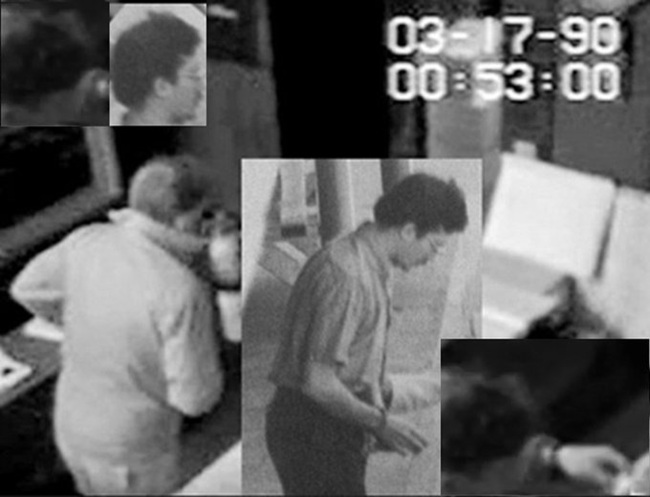
Pictures of Gardner heist eve video visitor March 17, 1990 (left) and Rod Ramsay in Tampa, FL after his arrest on espionage charges on June 7, 1990 (right) Best, Steve Kurkjian There are no question marks in Kurkjian's email because there are no questions in his email to Navarro. Kurkjian doesn't directly ask Navarro anything. Perhaps that's how the pros handle it when they're "in a very delicate, very tentative situation," as Kurkjian described at the Southborough library, just not with potential problem sources like me. "The most important thing is to keep [your] eye on the narrative," Kurkjian told an interviewer in December of 2015, and my information was not going to be shoehorned into Kurkjian's and the government's publicly disseminated narratives of the case. I was a narrative breaker. If Navarro had ever run across any Gardner connection with Ramsay, the whole world would have known about it or the whole world was being kept in the dark about it. And if the whole world was being kept in the dark, Kurkjian provides no reason for Navarro to change course after 24 years, at least in the email he shared with me.
Also since the Gardner heist took place in the heat of a historic espionage investigation and trial, the details of which including any possible involvement in the Gardner heist could be classified. After his arrest, Ramsay waived his right to a speedy indictment and trial and declined numerous requests for interviews. He was placed in solitary confinement in the Hillsborough County jail for 13 months, unsentenced, unindicted, and uncharged. Ramsay was indicted in July of 1991, but the indictment was not unsealed for an additional two months and there was no announcement of the indictment. signed a plea agreement in August, but that remained under seal until September as well. Authorities gave no explanation for the secrecy or the sudden unsealing of the case. He remained unsentenced and in solitary confinement for an additional 14 months. "As part of a plea agreement, government censors must clear any of Ramsay's future writings about his espionage activity or the investigation of it." In addition, Ramsay agreed to give the government any future profits from the telling of his spy story." "As part of the agreement, Ramsay also said he would take periodic polygraph tests." What information did Ramsay have that they were worrying about him sharing? He had been out of the Army for nearly seven years? What profits did he stand to make from his "spy story?" Even if Ramsay shared information with another person who turned that information into a book or movie, any money Ramsay received would belong to the government according to his plea deal. And making these details of his plea deal public, would serve to ward off any journalists, who hoped to capitalize on the life and times of the "career criminal," and spy Rod Ramsay.Before the Gardner heist Ramsay was permitted to drive a cab in Orlando, FL with its numerous military training and other military facilities at that time, but in prison, after the Gardner heist, he was asked to agree to take periodic lie detector tests, to make sure he was not passing along classified information. Kurkjian does acknowledge that Ramsay and the other roommate look somewhat like the sketches of the two thieves." But besides that he just has some conjecturing from a local individual, whom he falsely claims "urges him to consider that Roderick Ramsay might have played some role in the Gardner heist."Despite what Kurkjian says in his email, I did not urge him to do anything. He asked me questions and I answered them. He implied that his emailing Navarro has as much, or more to do with my urging him, as with his having seen one or more details in the information I sent, or something that I had said, that had him looking into Ramsay's possible involvement. The information I presented in my email to Robinson began: "Could a couple of former military boarding school classmates, Roderick Ramsay and [name deleted] be the culprits in the Gardner Museum Theft?" There was no urging, no call to action, I was just presenting the information for Robinson's consideration. Kurkjian did not share the information I sent with Navarro, to my knowledge, which could have caused him to think harder about the possibility that Ramsay was involved. Not only does Kurkjian not ask Navarro a direct question, he does not even explicitly suggest that Navarro consider the possibility that Ramsay was involved. He just suggests that Navarro share it with him if he had "run across any Gardner connection with Ramsay." Navarro replied to Kurkjian's 3 a.m. email at 7 p.m. that night.Subject: Re: from Steve Kurkjian, Re: Roderick Ramsay To: Stephen Kurkjian "Stephen, interesting story," Navarro begins. What story? The story, as told by Kurkjian in 200 words, is that someone, who is "conjecturing" that Rod Ramsay was involved, and that Ramsay and his roommate, who both look somewhat like the Gardner heist police sketches in Kurkjian's own view, is urging him to consider Ramsay as a Gardner heist suspect, and so he, Stephen Kurkjian, a three time Pulitzer Prize winner and the lead reporter for the Boston Globe on the Gardner heist case, is just casually emailing Navarro at three o'clock in the morning about whether he had ever run across any Gardner connection with Ramsay. That is not a very interesting story, unless it is quite possibly true.At no point in his reply does Navarro address the issue of whether he had "ever run across any Gardner connection with Ramsay." Instead Navarro answers the major question, not asked by Kurkjian, which is this: Would it have been possible for Ramsay, seemingly scraping by as a cab driver, at Orlando International Airport, and possibly unemployed, to have robbed the Gardner Museum? To that question Navarro offers nothing close to an iron-clad alibi: "For nearly 6 months, including the period you indicate, [What period exactly is that?} Ramsay was under surveillance and or meeting with me almost twice a week but at least once a week and at the time; also, sources close to his employer (cab company) showed him going to work every day. His phones were being monitored so I don't know how it would be possible. Do you have pictures of the bad guys?Navarro knows exactly when he met with Ramsay in March of 1990, and in every other month and year, or has an easily accessible record of his exchanges. Six months after Kurkjian's email to him in August, it was reported Navarro had sold the film rights to a book, which had not yet been written, about his investigation of Rod Ramsay, to George Clooney's Smokehouse Pictures. 
Announcement by author and ghost writer Howard Means that Joe Navarro had sold the film rights to his Rod Ramsay story to George Clooney's Smokehouse Pictures If Navarro had a meeting with Ramsay around the time of the Gardner heist he could have easily told Kurkjian. When his book came out, two and half years after Kurkjian contacted him, there was no mention in his book of a meeting, explicitly, or implied that took place between Navarro and Ramsay in March or April of 1990. Half of the first 14 chapters after the chapter title, start with the date, like a diary entry, in the pre-1990 chapter headings. In the entire book, however, the term "1990," only appears twice. One mention was for a meeting he had with Ramsay on February 12, 1990, in the chapter heading. But after that chapter the book becomes abruptly date-free. The only other time "1990" appears in the book, was a reference to the date of Conrad's conviction for treason in West Germany, "June 6, 1990," which was the day before Ramsay's arrest (detainment.) The month of May is only referenced when Navarro wrote of "being ordered to go testify in Germany during the week of May 6 [1990]." On the matter of the FBI's surveillance of Ramsay at the time of the Gardner heist, Navarro wrote: "These days Rod is driving a cab—and not his own. Every day he picks up a vehicle that he may or may not ever have driven before and spends up to twelve hours or longer behind its wheel, much of that time at Orlando International Airport, waiting in a long queue to pick up whoever happens to be at the front of the line when he gets there. Once he has a fare in the backseat, he goes wherever the customer directs, in a yellow cab identical from the air or ground to perhaps two thousand other yellow cabs working the streets of Greater Orlando. Put a bug in Rod’s cab? Which one? Make sure all his fares are our agents? Just imagine how many man-hours would be consumed standing in cab queues at the airport, not to mention the expense for the perpetual fares. And how would you ever time things so our agent was at the head of the line every time Rod’s turn came up? (God forbid that one of the agents might need to take a piss and screw up the entire cab-rank rotation.)" Ramsay had chosen one of the absolutely lowest paying jobs, that of cab driver, for someone just starting out. He had no salary, no hourly wage, and no minimum wage. He rented the taxi and kept whatever was left over after paying the rental fee to Yellow cab. "It's a task tried by hundreds of people each year. Some make a career of it; others, like Ramsay, disappear." Ramsay had only been in Florida for a couple of years, and had settled not in Orlando, but Tampa. Knowing he was under investigation for espionage, Ramsay started a job driving a cab, with no base pay, in an unfamiliar city. "The cab driving gig, however, did manage to be the most challenging occupation imaginable in terms of the FBI conducting surveillance on him. But if it ever occurred to Navarro or anyone else that Ramsay might have chosen to be a cab precisely because it would make surveillance difficult, he never shared those concerns in his book, or the difficulties of having him under surveillance, or in his email reply to Kurkjian. An added challenge was that the FBI was trying to have Ramsay under surveillance without his knowing about it. "This isn’t TV surveillance," Navarro continued. "This is the real thing. And you’ve got to be on your toes at all times because it’s easy to detect surveillance if you know what you’re doing." "Screw up our surveillance, overplay our hand, spook Rod Ramsay too badly, and we’ll end holding the same empty bag—with, to my mind, even bigger secrets unrevealed." Later in the book, Navarro described one discussion with Ramsay, where he chose his words carefully to avoid "tipping Rod to the fact that we had a tail on him."Orlando had a large military presence at that time. It included the Orlando Naval Training Center, the Orlando Recruit Training Command, as well as the Navy Nuclear Power Training Command. For the time Ramsay was working there Orlando also had the potential to be the home of the Ramsay espionage operation from out of his rented Yellow Cab. "Thanks to Disney World, Epcot Center, SeaWorld, and a dozen other lesser tourist destinations, Orlando probably has as many for-hire car services per capita as any place in the United States," Navarro wrote.Also more members per capita in the United States of the nomenklatura, the elite, communist party members in the crumbling Soviet Union and its Eastern bloc satellite countries, bringing their family on vacation there, per capita as well, south of Arlington, Virginia. With family vacations as a cover, Orlando was known to be a hot spot for espionage activity. It is unthinkable that given the legal peril Ramsay found himself in, as well as the immediate and continuing financial strain he was under, that the government was not keeping close tabs on him, unless they were convinced that any information he possessed was so compromised, outdated, adulterated, or otherwise obsolete, so there was no point in worrying about it. There was still the possibility, however, he could get involved with new espionage or criminal projects. By the time of the Gardner heist, Ramsay was cooperating fully and getting kid-gloves treatment in the hopes of his continued assistance. Six weeks before Ramsay's arrest, twenty months after Navarro's initial interview with him, he fretted over telling Ramsay that he was flying to West Germany to testify against Clyde Lee Conrad. "I think long and hard about this, telling Rod what I’m doing. Is he more likely to bolt if he hears secondhand, through the press or maybe some buried contact, that I’m testifying at Clyde’s trial or if I tell him myself? (Navarro acknowledges that Ramsay could have contacts in the espionage world a month before his arrest and a month after the Gardner heist.) "Either way," Navarro continues, "the risks are huge. Rod is fluent in German, Japanese, and Spanish; he could lose himself in any one of dozens of places, not excluding Russia itself. And of course, he’s inherently volatile with a proven track record of reckless behavior [emphasis mine] and rash decision-making. Apparently Ramsay still had his passport, if Navarro was worried about his leaving the country. A passport photo of Ramsay appears near the end of Navarro's book. There was nothing preventing Ramsay from leaving town. He had a strong incentive to cooperate with Navarro and FBI investigators because that would figure into what kind of a sentence he would receive for his admitted acts of espionage. At the same time the fact that he had cooperated so fully and still did not have a deal with the feds must have weighed on him. He was already commuting to Orlando airport. Maybe he just decides one day to get on a plane. There were no legal limitations on Ramsay's travel, and he can't be faulted for ducking surveillance by getting on a plane if he was not supposed to know he was under surveillance. He certainly had ample opportunity since he started each workday at Orlando airport. Another possibility is that the FBI had him under surveillance, was aware that he was getting on a plane, and chose not to impede him, but instead to follow him, in the hopes of finding out more about his activities and those of his associates. In addition Navarro says sources close to his employer, not his employer, but "sources close to his employer (cab company) showed him going to work every day." Nobody works every day. When someone says that somebody came to work every day that generally means they were reliable. They came on the days they were scheduled. They did not take a lot of unscheduled time off. As it is generally used, it does not mean literally that they came to work every single day. Ramsay sometimes worked as a cab driver at night too, according to Navarro's book.Since cab drivers who rent their taxis like Navarro says Ramsay did, are not employees. They are independent contractors. With "the hours upon hours he spends waiting in line at Orlando International every day in a cab he can pay the rent on only if he gets more fares than time permits." Why don’t you work the hotels, Rod,” Navarro suggests at one point. Good question, agent Navarro! But Navarro writes that the sources showed him working every day. This suggests some kind of a record, like a payroll record or cab rental record. If Ramsay was under surveillance, then the FBI would have logged the dates and times of his cab rentals. Surely in the "thirty-six volumes of material and hundreds of pages" about Ramsay there would be payroll records or cab rental ledgers showing the time and dates of his work. Furthermore, after his arrest numerous news reports described Ramsay as an unemployed cab driver: "Ramsay told the FBI he made $20,000 for his spy work, but at the time of his arrest he was an unemployed cab driver so financially strapped he was living at his mother’s tiny trailer in Tampa and sometimes slept in his car, Navarro said." But Navarro, in his email to Kurkjian makes no reference to the fact that Ramsay was unemployed at the time of or shortly after the Gardner heist. "Officials at Yellow Cab Co., where Ramsay worked, could not be reached to confirm the dates of his employment, although he appeared to have worked there from last summer to to this spring, the Orlando Sentinel reported a few days after Ramsay's arrest on June 6th. "Spring" started on March 20th of that year. The Gardner heist was on March 18. Meteorologists and climatologists actually consider March 1 the beginning of spring. There is no precise time of when Ramsay left his job, but it was around the time of the Gardner heist. Florida's "Spring Break" season typically starts around the second weekend in March, or March 10th, in 1990. Navarro says Ramsay's phones were monitored, but according to a newspaper story from the time of his arrest, "a fellow cab driver who felt sorry for Ramsay had let him stay with him at one point. But he was incensed by news of the arrest and headed to the FBI with phone bills detailing Ramsay’s long-distance calls, drivers said Saturday." Who was Ramsay, the "nice guy, kind of quiet, who found himself in such dire straits, calling long-distance at that time? It would have been impossible to monitor Ramsay's telephone use, never mind listen in and record conversations at all times. In 2000, there were 1100 pay phones at Atlanta's international airport, the busiest airport in the country, about twice as busy as Orlando. There were likely several hundred pay phones at Orlando airport alone, and payphones would be ubiquitous in a tourist destination, like Orlando, most particularly in the areas where a cab driver was likely to find themselves. There was no way to monitor Ramsay's use of telephones in a way that he could not thwart, with little effort. So not exactly an iron clad alibi. Furthermore, Navarro left the door open to further discussion on the question of Ramsay's possible involvement by ending his email to Kurkjian: "Do you have pictures of the bad guys?"If Ramsay's alibi was a certainty, or he was suggesting it was, he would not have asked this question. And that was all she wrote for Kurkjian and Rod Ramsay's possible involvement in the Gardner heist. Based on the information I had shared and Navarro's email response, he considered Ramsay's possible involvement "far-fetched," he wrote in an email to me. He did ask me about the other participants, who went into the bank with him in the Vermont bank robbery he was involved in and "plotted." But I did not have that information at that time. A month after my interview with Kurkjian, filming on location in Boston began on the Academy Award winning movie Spotlight, Two months after that, the security guard Rick Abath, whom Kurkjian told me he intended to contact about the people mentioned in my information, posted a picture of himself standing between two guys who look like the Gardner heist police sketches, one wearing round gold frame glasses as was part of the description of the suspect and identical to a pair worn by Rod Ramsay in his mugshot photo taken eleven weeks later, and the other who looked like the police sketch of the other Gardner heist thief. 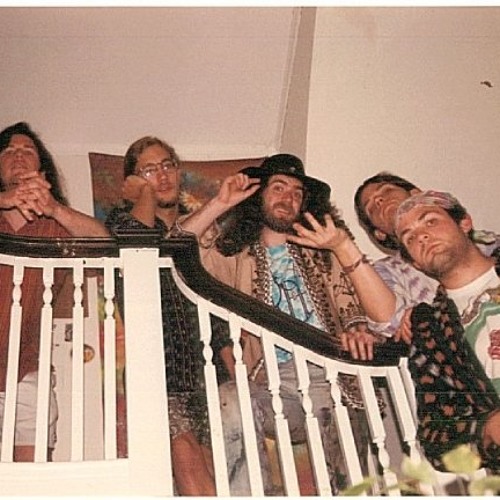
Comparing associates of Rick Abath (in black Stetson) with police sketches, FBI suspects, Rod Ramsay (mustache and glasses) and Ramsay's Boston roommate In 2017, when the book "Three Minutes to Doomsday" came out I told Kurkjian about it, at the Boyden Library in Foxboro, on April 6, 2017. "Is there anything about the Gardner heist in it?" Kurkjian asked me. It did not. But if Kurkjian was asking, maybe the possibility did warrant further investigation, but Kurkjian and the Boston Globe were not the people to do it, and seemed to be doing quite well for themselves, pumping out the FBI's disinformation talking points. I followed up the following day with an email to Kurkjian about the problem I had with the government blaming the heist on, Leonard DiMuzio, an honorably discharged Viet Nam era Marine Corps NCO, and the victim of an unsolved homicide, and also George Reissfelder, a white collar criminal, who "spent half of his short adult life in prison for a crime he didn't commit." Reissfelder died of an overdose, but now Geoffrey Kelly suggests that Reissfelder was actually murdered, which would make him, like DiMuzio, a victim of an unsolved homicide."There is zero possibility these guys did it and they know it," I wrote to Kurkjian in an email, after seeing him in Foxboro. It is not their theory. And then the government does not even have the guts to come out and say that's who they think did it and accept the consequences of their lies. And yet they not only don't have the media challenging them or ignoring them, they have you putting it in the newspaper that that is who they think did it under your byline. I have said who I think did it and I have it as a pinned tweet on my Twitter page for over a year. And the people I'm talking about are alive." "Kerry, let's not get too driven here," the same Kurkjian who reportedly "dives deep into the underbelly of Boston’s crime syndicates of the 1980s and 1990s." according to the Dorchester Reporter. "Let's remain friends," Kurkjian continued, "but I'm not going to go down these rat holes [not rabbit holes, rat holes] with you as it doesn't do your mental health any good. Have your wife say it's ok and then I'll consider it. But let's talk of more interesting stuff like the Red Sox and the Pats until then.Only 15 months earlier Kurkjian had asked me three times to meet with him in my home state of Rhode Island. He proposed having lunch at an Irish pub. Originally, I did agree to meet with him, but then I changed my mind after an email exchange with Anthony Amore about, which amounted to one more thing that made me decide he could not be trusted. Kurkjian's proposal came after I had sent him an email after attending a lecture of the Gardner heist case he gave at the Weston Public library on January 20, 2016. We exchanged small talk briefly, but nothing about the Gardner heist, and he was not aware that I was someone he had conducted a telephone interview with about the case a year and a half earlier. I was leery of meeting with him after the past experience of our phone interview. I contacted Anthony Amore at the Gardner Museum, about the idea of meeting with Kurkjian. We had exchanged dozens of emails from August to October of 2013 about my thinking on the case and my belief that Ramsay was involved. By that time too, I had a Twitter account with numerous tweets examining the possibility that Ramsay should be a suspect. The information I shared with Amore the previous year was pretty much the same information which Kurkjian had seen. Amore gave me reason to be mistrustful of Kurkjian. Amore: "Kurkjian throws whatever he can against the wall in hopes that it will stick. Just look at the book!!!" Amore wrote. As well as: "I think you have a good sense of how Kurkjian operates. For instance: that story about the shed is inaccurate. But then again, so are pages 1-300. Another example: I never, ever, gave anyone including Elene Guarente $1, never mind $1000. It's a complete falsehood. You seem like an extremely bright and savvy individual. You should follow your instincts on meeting with him. I'm a believer that our gut reactions occur for a reason."Subsequent emails from Amore stated, "Keep in mind that you owe him nothing; he's not anywhere close to getting to the bottom of this; and you have nothing to gain from it," and "Beware of 'off the record' promises, Kerry." During the time that Kurkjian was trying to set up the interview with me, he sent me a couple of out-of-the-blue emails about matters related to the Gardner heist case, but which we had never discussed. In one email, sent to me on January 21, 2016, Kurkjian wrote: "I heard they were battling - [Robert] Fisher, the new prosecutor in the case, was frustrated by how little spadework had been done by the FBI. But there's a major disconnect between what the US attorneys office wants to get done and the approach that the feds take in an investigation."In the original information I had sent to Robinson that was forwarded to Kurkjian and was the basis of his interview with me, I had written about how the FBI might have been reluctant to prosecute Ramsay. And now here was Kurkjian, a year and a half later, supporting my contention that the FBI might have been reluctant to "solve" the Gardner heist case at the outset. My 2014 document to Robinson at Watchdog New England stated that "It would be embarrassing for law enforcement if Ramsay had done this crime since questions would arise as to why he had not been arrested earlier, as well as how did he get into the position of stealing classified documents in the first place." "Ramsay is an embarrassment to the government," I wrote. "How did this boarding school bank bandit, daily pot smoker from the age of 15 ever get a top secret security clearance, [ever] get entrusted with our nation’s most vital secrets?" "How is [it] that this most odious of enlistees wound up working directly under the head guy in the longest running espionage conspiracy known in the history of the United States?" To my knowledge, Kurkjian has never shared this information about the federal prosecutor's frustration with the FBI's "spadework," in any of his writing about the case. In fact, Kurkjian stated quite the opposite, the following year in a radio interview on WNPR he said that "It's known as the largest art heist in world history and for 28 years the FBI has labored diligently...and they have chased down every lead but come up with nothing." Stranger still was an email I received hours earlier from Kurkjian that same day, with the subject line: "Obrien(sic) license." The email included no text, nor additional information, only an attached image-file. It was a photocopy of retired Army Lieutenant Colonel Lawrence O'Brien's driver's license.
Drivers License of Retired Army Lt. Colonel and Gardner Museum Supervisor Lawrence O'Brien who died in 2015 sent to me by Stephen Kurkjian "Though it has been discounted by investigators," Kurkjian reported in the Boston Globe two months earlier, "four of the former guards had told Kurkjian they believe the person in the Gardner heist eve video, released on August 6, 2015. The article also reported that "Two former guards who knew O’Brien well told the Globe they do not believe the man in the video was O’Brien. His brother also disputes the ID."

Comparing Gardner Museum Security Supervisor Larry O'Brien with video still-shots of heist eve videos from Gardner security camera I notified Kurkjian that I was no longer interested in meeting with him. Kurkjian replied back: "Kerry: I did review the various postings on your Facebook page and marveled at their serious reporting and analysis. There's only one other non-reporter whom I know who has shown such interest and analysis and have spoken/emailed with him for more than a year to know which areas he is strong in. I've been working hard on this case for more than a decade but have done that solely on my own. While I have my theories of the areas that need further reporting/analysis, I gain so much from the analysis and hypothesizing of others. Before you hang them up, grant me this one lunch so I can hear your latest best theories. You could see from our private chat last night, I'm not a know-it-all. I gain most from hearing what others think, and would value the lunch immensely." Nine months later, on October 24, 2016, I received another email from Kurkjian, trying to set up an interview with me. "Hi Kerry: I see from a recent tweet forwarded to me today by my son-in-law that you remain interested in the Gardner case. It's been nearly a year since we spoke after you attended one of my talks on my book "Master Thieves." You able to talk the case over now?" I shared the email with Amore who then emailed me, "Another caveat: I meant to tell you: If you have "Master Thieves," you'll note that a woman named Donna is quoted regarding George Reissfelder. I know her well. She told me that she told Kurkjian she would only talk on the condition of anonymity. He agreed. Then he listed her name AND the town she lives in now." It had been over two years since Kurkjian had interviewed me and three years since I had shared preety much the same ideas with Anthony Amore. Kurkjian was for the second time in ten months, trying to meet with me, and Anthony Amore was trying to dissuade me from doing so. Both Stephen Kurkjian and Antony Amore must have thought there was something to the information I had shared with them, to take this kind of an interest.. That was the last I heard from Stephen Kurkjian or he from me until January 22, 2021, a couple of months before the release of the Netflix Documentary, This Is A Robbery, about the Gardner heist case. It had been four years. Shortly after the documentary's release, the Armenian Mirror Spectator published a story about Kurkjian, and his role in the Netflix Gardner heist documentary series "This Is A Robbery." "It is not often one gets to talk to the star of a Netflix series, "but Stephen Kurkjian is not a typical star." His "book, Master Thieves, served as a starting point for the Netflix series and that Kurkjian served as a production consultant." In his email to me, two months before the Netflix documentary came out he said: "Hi Kerry: I happened upon your website for the Gardner theft, and was impressed with how factual and comprehensive it was. Congratulations. But I don't think you gave full enough attention to the reporting - and the speculation that I built on that reporting - on Donati-Ferrara account. Plus while I may have overlooked it, I didn't see anything on the connection between Donati and Robert Guarente that I had in "Master Thieves," the LAST SEEN podcast and The Globe, and how that friendship may provide an explanation of what happened to the paintings. Keep up the good work. It's good to see that you've put all that hard work you've spent on the case presented in an orderly, worthwhile fashion." The reason why I had not given any attention "to the speculation" Kurkjian "built on that reporting," and the reason I had not gone into "the Donati-Ferrara account" was because it was based on fourth-hand information. It was what Kurkjian said, an anonymous source said, Ferrara claimed Donati said 23 years after Donati died. There is no additional sourcing of anything Kurkjian has referenced supporting Donati's involvement in the Gardner heist, which is likely why other news media never picked up on the story either. In "Master Thieves" Kurkjian does claim an unnamed source told him that a friend of Bobby Donati's, Donny "The Hat" Roquefort, like the cheese, saw him carrying two Boston Police uniforms, shortly before the Gardner heist, and that Roquefort, like the cheese, ran a social club in Revere called "The Shack." According to Vincent Ferrara's former attorney, Anthony Cardinale, Bobby Donati did have an associate, named Donald Rochefort (not Roquefort) a.k.a. "Donny Shacks." He was an ex-boxer who worked in the financial services sector, not the hospitality industry. The existence therefore of a social club called "The Shack" is questionable. And Kurkjian does not even claim he received this story directly from Rochefort. Kurkjian's tale continues that shortly before the Gardner heist, a close friend of his noticed that Donati was carrying two Boston police uniforms, and so he "pressed a taser playfully into Donati’s side and pulled the trigger," which "did quite a number on Donati." Of this claim Cardinale told me, "There’s no way anyone tased Donati and didn’t wind up in an intensive care facility or underground." So Kurkjian's uncorroborated, second-hand story about Donati and the police uniforms includes a misspelling of the witnesses surname, an incorrect nickname, an incorrect occupation, possibly a nonexistent social club, and a major element of the story is discounted as impossible, by someone who knew Donati. An uncorroborated story with this many holes in it, does not pass muster, which is why nothing about it can be found on my website, except maybe something about how dubious the story is.Further, there is no discussion of any connection between Robert Guarente and Robert Donati in any way in Last Seen Podcast, as Kurkjian claims in his email to me. Donati's name and Guarente's names are not even mentioned in any of the same episodes. The only episodes of Last Seen Podcast where Guarente's name is mentioned are episodes 5 and 9. The only episode of Last Seen Podcast where Robert Donati's name arises is in episode 7. In a 2012 Boston Globe article by Kurkjian wrote: "Guarente knew Robert Donati, one of the first potential suspects named," in 2012. That is the entire extent of the Boston Globe ever linking Robert Donati to Robert Guarente in any way. The only exception is a diagram in the print version of the Boston Globe, a couple of days after the FBI's 2013 press conference, but without any reference to their connection in the accompanying article. 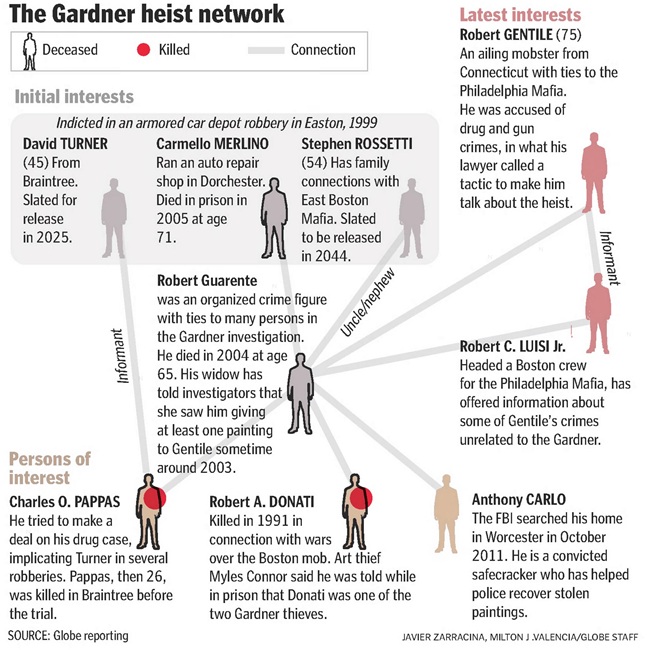
The thin gray unsubstantiated line linking Robert Guarente and Robert Donati in the Boston March 20, 2013 print edition In one article Kurkjian supports his claim that Guarente might be involved, by asserting without any evidence that after he got out of prison Guarente invited old friends up to his new home in Maine. "Among those he hosted was Robert Donati of Revere, and David Turner of Braintree, whose names have been associated for years with the Gardner theft." In another article just two weeks later, Kurkjian suggests Donati might be involved because "Donati was also a close friend of Robert "Bobby" Guarente, a former bank robber who has been linked to the Gardner crime." This article has a mugshot photo of Donati from 1961, although Kurkjian's own book has two photos of Donati taken decades later, the later one, looking like someone not capable of robbing the Gardner Museum.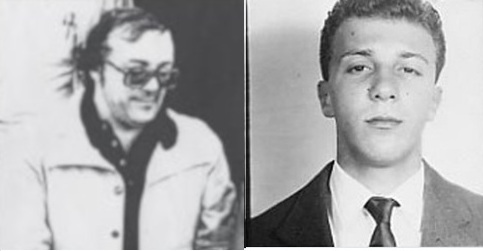
Mugshot photo taken of Robert Donati 29 years before the Gardner heist used on Wikipedia, "Last Seen Podcast" and Netflix' "This Is A Robbery" (right). Much more recent photo of Donati in Kurkjian's book "Master Thieves" (left) Kurkjian said that Donati and Guarente were great friends in the Netflix This Is A Robbery. He said Donati was great friends with Myles Connor in the same segment, episode 3, of the Netflix series. Bobby Donati was very popular. But he was also potentially very unpopular. Every time Myles Connor hooked up with his pal, Donati trouble followed. "When he [Donati] told me he found a buyer for the [stolen] Wyeths, I made certain assumptions," Connor wrote in his memoir."'We can trust this guy, right?" I asked." "Bobby nodded. 'Absolutely'" On the run, after skipping out on his trial, for trying to sell the "Wyeths" to an FBI undercover agent, it was shortly after an excursion with Donati to the Gardner Museum, years before the 1990 heist, that after being in hiding in Cohasset, MA for months, Connor was arrested by the FBI.Was Donati an informant? At the time that Donati was killed in 1991, "Donat was said to be making collections from bookmakers and loansharks on behalf of Vincent Ferrara, who was then awaiting trial on federal racketeering charges with Raymond (Junior) Patriarca." Six years after he died, it became an issue in a Mafia trial in federal court about whether or not Donati had been an informant. On June 13, 1997 the Boston Globe reported that acting Assistant Attorney General Seth Waxman was threatened with contempt by US District Judge Mark L. Wolf, for refusing to disclose whether or not Donati and three other men were informants. Eight days later it was reported that Waxman, who had been threatened with jail time submitted an affidavit that Donati had not been a federal informant.Three days later, however the Boston Globe reported that "Anthony M. Cardinale, lawyer for indicted New England Mafia boss Francis P. "Cadillac Frank Salemme and codefendant Robert DeLuca said the defense had just learned that Donati "may have been the unnamed informant who wore a hidden device to record conversations of convicted Mafia captain [his boss] Vincent Ferrara," the Mafioso gang leader, who according to Kurkjian, claimed Donati stole the Gardner art to get him out of prison. "Lawyers for five alleged organized crime figures argued yesterday that Donati was actually an informant for the State Police." That is a distinction that would be a good deal less important to the organized crime chiefs, like Vincent Ferrara, Donati was said to have informed on, than the federal judge deciding the fate of the accused organized crime figures. Donati's body was found bludgeoned and stabbed twenty-one times, in the trunk of his Cadillac, a short distance from his home, a mob hit more in line with that of a snitch, than that of an opposing soldier in a gang war. But in his book, while Kurkjian's offers a few theories about the reason for Donati's murder: It was because he owed money, or he was "possibly a victim of the Boston gang war raging at the time," (a gang war that in 1990 existed only on the pages of copy written by Stephen Kurkjian) or something to do with the Gardner heist."The heavily reported question of whether or not Donati was an informant, which arose in a federal courtroom six years after Donat's death, and was consistent with the manner of his execution, is never raised as a possibility, by Kurkjian or Geoff Kelly in his 2026 book about the case, and in it suggests that Donati’s murder was related to the Gardner heist. Attorney Cardinale, in twitter DM's exchanged with me, dismissed the possibility of Donati having been one of the Gardner heist culprits, writing "Bobby Donati was a knock around guy who was essentially Vin Ferrara’s 'driver' (who I was then representing). When I met him [Donati], circa 1988-9, he was, in my humble opinion, not in any way involved [in the Gardner heist], just not what he would have been doing at the time." In Netflix This Is A Robbery, Kurkjian states that "the day after Bobby Donati went missing, his son picked up the phone. Whom did he call looking for his father? He called Bobby Guarente. Donati…and Bobby Guarente were great friends. These guys grew up together in the East Boston neighborhood. They knew each other."Donati's son likely called Guarente because he was someone who might know what happened to his father, and not as a shoulder to cry on. Donati's son likely called Guarente because he was someone who might know what happened to his father, and not as a shoulder to cry on, the name of a good grief counselor. Guarente was someone who would possibly know if Donati, who worked for Ferrara, had been targeted by the rival Salemme gang. Martin Leppo, who once represented Robert Guarente, said in the same episode of This Is A Robbery, "Bobby Guarente was somebody who was very personable, and was not ashamed to have his name be mentioned and to this spring,associated with a lot of tough people." In the CNN Gardner heist documentary "The Gardner Heist Stealing Beauty" on How It Really Happened with Jesse L. Martin Season Eight Episode 5 in May of 2024, Kurkjian went so far as to say that "Bobby Donati gave the art to his great friend, Bobby Guarente."Kurkjian suggested I look in his book to learn about the “the connection between Donati and Robert Guarente.” I did not find a "connection," except for two unsubstantiated claims by two unreliable sources that Guarente and Donati knew each other. The only connection between Donati and Guarente in Kurkjian's "Master Thieves," were the unsubstantiated claims of people I did not deem reliable. One was, Elene Guarente, who also "told the Globe that her recollection of the painting [she saw her husband give to Gentile] did not match any of the paintings and sketches authorities showed her." Kurkjian reported in the Boston Globe. If Guarente is credible, then whether or not her claim that Donati and Guarente knew each other is moot since she says she did not see her husband with any stolen Gardner art anyway. Minus Elene Guarente there is nothing connecting Robert Guarente to the stolen Gardner art.The other person who claimed Donati and Guarente were friends was Earl Berghman, who partnered with Jeanine Guarente, Guarente’s daughter from an earlier marriage," after she told him that she had seen Rembrandt's "Storm on the Sea of Galilee," in her father's home. But "twice in a matter of months Jeanine produced what she claimed were chips she had collected from paintings her late father had at their home in Madison, Maine. "Twice, an attorney Berghman and Guarente had hired, Bernard Grossberg presented them to Arnold Hiatt, a trustee for the Gardner Museum. But on both occasions the chips turned out to be fakes. In fact, the second batch turned out to have come from the edges of a magazine that someone had snipped off," “Kurkjian wrote in Master Thieves.” The fact that one criminal knew another criminal, by itself, is not any kind of proof or evidence that they were involved together in any particular crime. In total, you have weakly established information linking Donati to the theft, weakly established information linking Guarente to the stolen art, and weakly established information linking Guarente and Donati to each other.Both Myles Connor and Vincent Ferrara claim that Donati told them that he took the art to bust them out of prison. The only connection between the two of them is that Donati may have informed on both of them, and may have either been trying to see if he could get more information out of them, to share with the government, or to gauge whether or not either of these two incarcerated past associates, had any suspicions about him. It was a potentially risky move, unless someone had given Donati assurances that nobody would be coming forward to contradict his supposed claim of having robbed the Gardner Museum What I did find in Kurkjian's “Master Thieves,” was not a connection, but the opposite of a connection, a disconnection, and a potentially fatal one if not maintained. I discovered the impossibility of Donati and Guarente working together on the Gardner heist. In his book, Kurkjian writes that Donati was a "confidante of and driver for Boston mob leader Vincent Ferrara who reportedly told Ferrara that he had pulled off the Gardner robbery to try to gain Ferrara’s release from prison.""On the same page Kurkjian writes that "Vinnie Ferrara was co-leader of the renegade Boston mob group that fought Frank Salemme for control of the region’s underworld in the 1980s and ‘90s," and then on the very next page he writes that Guarente was "a loyalist to Frank Salemme and his underworld gang." Later he wrote how Guarente was personally involved, according to sources, in the execution of Richard “The Pig” DeVincent, for fraternizing with members of a rival gang, just like Kurkjian claims Donati and Guarente were doing, since he claims they were "great" friends: An FBI report attested to Guarente’s involvement with organized crime figures, Kurkjian wrote. "During the battle for control of Boston’s underworld in the 1980s and ’90s, he [Guarente] was aligned with Frank “Cadillac Frank” Salemme. Guarente was designated by his bosses to make it clear to Richard “The Pig” DeVincent, whom he knew from prison in the early 1980s, that he needed to stop associating with a rival gang seeking the same power." Like DeVincent, Donati a Ferrara loyalist, was in a rival gang seeking the same power. DeVincent did not heed Guarente’s advice and was shot to death in 1996, an execution witnessed by Guarente and a member of the Rossetti crime gang, according to the FBI. Guarente was quoted by an informant as saying that another witness’s gun had jammed in shooting DeVincent and that “it was a good thing my gun was working properly.” In fact Kurkjian's own source in claiming Donati robbed the Gardner to get Ferrara out of prison, insists that Gaurente, and David Turner, whom Kurkjian claims was a Guarente "thug" protege, were not involved.
From Master Thieves:
"I told him that as far as I could tell, the FBI was certain the heist had been arranged by David Turner, who had
turned the stolen art over to Robert Guarente, who before
he died in 2004 had given at least several of the paintings to
Robert Gentile."
So while there is an overwhelming amount of poorly laid out information about a gallery of local toughs, who may or may not have been involved in the Gardner heist, there is barely anything about the actual investigation in Kurkjian''s book, or for that matter in Ulrich Boser's book or in Geoff Kelly's Gardner heist book. What happened between the time of the heist and when Youngworth popped up seven years later looking to make a deal with the museum to return the art? Kurkjian claimed on Netflix This Is A Robbery, Episode 3, that "Between 1990 when the theft took place and around 1997 there was nothing."
Brian McDevitt was questioned by the FBI in 1992, he appeared on Sixty Minutes to discuss the fact that he was a Gardner heist suspect, and was brought before a grand jury in 1993. “There was a day last autumn [1991] when Brian McDevitt, sitting in the office of his small loft house in Hollywood Hills, proposed writing a screenplay about a brazen art theft during which the thieves hid the stolen treasures deep in a German cave,” Brian McGrory, the current editor in chief of the Boston Globe wrote in June of 1992. Just a few weeks later, McDevitt found himself at the center of an investigation into the largest art theft in history, when the FBI summoned him back to his lawyer's Salem office and asked him what he knew about $200 million in paintings missing from the Isabella Stewart Gardner Museum in Boston. In that same episode Mashberg said: "Very remarkable that between 1990 and 1997 there were very few stories about the crime. There was never say an arrest or a suspect being questioned." In a sense, Mashberg was right. There was nothing, as long as people kept their mouths shut. McDevitt had stopped dong that, and then they quesioned him and brought him before a grand jury. The mysterious lack of adherence to professional standards by Robinson and Kurkjian at my attempt to constructively engage with them, as a source of input, about the the Gardner heist, as well as Kurkjian's consistent unprofessionalism as it pertains to his role as a journalist covering the Gardner heist case in the decade that followed, of which this report touches on is one more example of something that points to there being more going on with the Gardner heist case, than a crime for profit perpetrated by local gangsters, or a get-out-of-jail free card for one of their confederates. It also points to a problem with the free exchange of information through the mainstream media, that is accurate, fair and thorough, and not just at Fox News, and MAGA media. This problem persisted prior to the election of Donald Trump in 2016, whose victory received a big and unprecedented boost by James Comey, director of an FBI that had somehow, somewhere along the line become above reproach, even in Boston of all places, where the FBI's corrupt relationship with organized crime leader Whitey Bulger's criminal exploits and corrupt relationship with the FBI was a major news story a half dozen times for 25 years, from 1988 when the Boston Globe first reported he was an FBI informant until 2013 until he was convicted of multiple murders. Even when acting publicly in questionable ways, as was the case with the Gardner heist anniversary press conference on March 18, 2013, a nationally covered event whose stated purpose was to advise the public about progress in the case, which they didn't do, and to "appeal to the public for help, that they didn't want." But the only help the FBI really wanted was from the media, was to help them dominate the narrative, to help them to to distract, to deflect, to dismiss and to defame, to threaten and intimidate, and to lie without consequence, to transform the Gardner heist "mystery" into a sensational destination, where your questions are the only answers you ever need. And the media, both MAGA and mainstream, have been only too happy to oblige. As Rick Abath wrote in the first chapter of his barely started book on the Gardner heist case: by Kerry Joyce Copyright © 2026 All Rights Reserved
|