|
Convicted spy Rod Ramsay as a potential Gardner heist suspect (Part 1)
Convicted spy Rod Ramsay as a potential Gardner heist suspect (Part 2)
Convicted spy Rod Ramsay as a potential Gardner heist suspect (Part 3)
Convicted spy Rod Ramsay as a potential Gardner heist suspect (Part 4)
Convicted spy Rod Ramsay as a potential Gardner heist suspect (Part 5)
Full Report Downloadable pdf version
Convicted spy Rod Ramsay as a potential Gardner heist suspect (Part Five)
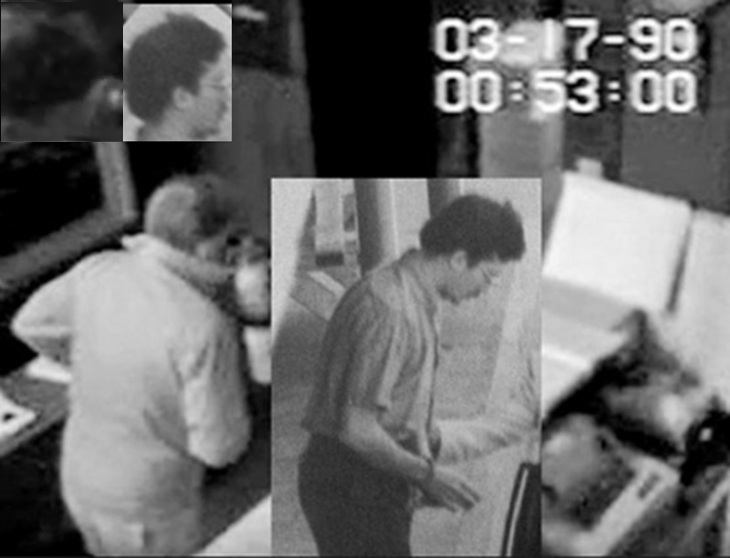 Picture of Gardner heist eve video visitor
March 17, 1990 (left) and Rod Ramsay in Tampa, FL after his arrest on espionage charges
on June 7, 1990 (right)
Picture of Gardner heist eve video visitor
March 17, 1990 (left) and Rod Ramsay in Tampa, FL after his arrest on espionage charges
on June 7, 1990 (right)
As desperate as the Gardner heist would have been, even for someone as desperate as Ramsay, it could at least serve as an opportunity to strike a blow against the city of Boston,
where his past misdeeds, he may have realized, or suspected, had come to light, as well as the government, which had used him.
Ramsay, the smartest guy in the room, who played at being a master archcriminal with Clyde Lee Conrad, like it was Dungeons and Dragons, for a couple of years,
might have suspected that while he thought he and Conrad were playing the U.S. Army, it was he and Conrad who were being played all along.
According to a 2022 article in Daily News Hungary, Lt. Col. István Belovai, a Hungarian Strategic Military Intelligence Service officer,
first got in contact with the CIA in 1982, to inform the Americans about the activities of the
infamous Conrad spy ring, one of the most damaging
espionage operations ever against NATO." Ramsay did not arrive in Germany until 1983.
(American and Western news media) place Belovai's dealings with the CIA beginning in 1984.
Navarro too, in Three Minutes to Doomsday, suggested that the investigation into the spy ring preceded Ramsay’s arrival at the Eighth Infantry Army Headquarters.
After quoting Ramsay as saying that he met with Conrad in Boston, in “maybe the spring of ’86,” he next writes that Conrad had been in WFO’s [the FBI’s Washington field office] sights for years by then.
The 1999 book Traitors Among Us by Stuart Herrington pushed back the timetable of the Army's awareness of the Szabo/Conrad spy ring back even further. Herrington wrote that
in 1978, six years before Ramsay set foot in Germany,
that CIA sources in Moscow advised ominously of “a Hungarian penetration that was regarded as the most lucrative espionage success in Europe since the end of World War II.”
CIA officials, realizing the importance of their agents' warnings, brought the grave news to the Department of Defense in 1978.
The agency tip led to what would ultimately become the longest-running, most sensitive, most tightly compartmented, and costliest counterespionage investigation in history. If the agency's spies were correct, NATO's ability to defend Western Europe against the Soviets and their Warsaw Pact allies was in jeopardy.”
Only after the investigation had been ongoing “for years,” was Ramsay assigned G-3 [War] Plans of the division headquarters, placed in the exact same position Conrad held, when he was recruited by Zoltan Szabo, whose former position Conrad then held.
In courtroom testimony, Navarro described Ramsay as someone with a high IQ, who spoke Japanese, Spanish and German. He was also said to have a remarkable gift of near total recall of whatever he read.”
In addition, as someone who graduated high school from the same military boarding school as Donald Trump, Ramsay would have had little trouble conforming to the rigors and traditions of military life, which would have reassured the senior NCOs and commissioned officers he worked under.
At the same time, Navarro also testified that before joining the Army on November 17, 1981, Ramsay had robbed a bank in Vermont, and while working as a security officer in a hospital, had attempted to break into a safe.
For Conrad to bring someone into his espionage operation, Navarro told Ramsay in one interview, he described in his book, “It had to be someone he trusted, someone who was really smart, someone who wasn’t scared to push the envelope, someone as smart as Clyde himself.”
“That would make perfect sense, wouldn’t it?”—with emphasis on the word “perfect,” Navarro wrote Ramsay replied.
A little bit too perfect, however, and Ramsay's reply suggests it may have dawned on him just how very a-little-too-perfect it all was.
As Rod’s mother said to agent Navarro, “Rod was assigned to that job, Mr. Navarro. He didn’t seek it out."
The odds of someone smart enough and criminal enough (an actual bank robber) to be relatable to Conrad,
and to wind up assigned by the Army to work directly under him, at the site of his decades long espionage operation,
as a records custodian for some of the Army's most top secret documents, was greater, much greater, than a one in a million shot.
While some spies are motivated by ideology, a shared culture, or national heritage, a personal grudge, or blackmail, Conrad, like many other spies,
was motivated by pure greed. For him, the records the Army entrusted him with safeguarding were just one more form of contraband he could use to make a profit.
With the breakup of the Soviet Union, Conrad saw an opportunity
to buy and sell classified documents to any and all governments, agencies, and actors; an opportunity to get rich.
Like Ramsay, Conrad's criminality was not limited to espionage.
"I've been a bad boy," Conrad admitted to Master Sergeant Danny Williams, who worked undercover investigating Conrad and wrote about his experience in a book called “Damian and Mongoose.”
"I mean a really bad boy." I've put buyers in touch with bank robbers who needed to get rid of some money. I've arranged buyers for stolen art. I have some of that [stolen art] on my wall right now," he said.
Conrad's operations, which combined acts of espionage with other forms of criminality like bank robbery and art theft, particularly as the state apparatus in the Soviet Union and the Eastern bloc crumbled, his gangster style of espionage, posed a new and dangerous challenge to America's national security.
The emergence of the spy/gangster could explain the federal government's complete and total take over of the Gardner heist investigation as well as the government's determination to never allow the original thieves to profit from the Gardner heist, if one or more of the perpetrators had been involved in espionage as well.
If something is too good to be true, it usually is, and it should have occurred to Conrad and Ramsay that their match made in heaven was a match made somewhere on earth, in the Pentagon perhaps, and not the result of random chance.
Since Ramsay had joined the Army so quickly after the bank robbery he committed, it may have taken some time for his criminal past to catch up with him, either through a criminal investigation of the bank robbery, or some other crime, or in the process of investigating him personally for his top-secret security clearance.
It could be that the crime-prone Ramsay was sent in deliberately to work under Conrad, with the idea, the hope, that Conrad, who was approaching Army retirement age, would recruit him.
Ramsay may have been a double agent, of a type known as
"an
unwitting double agent, an extremely rare bird. The manipulative skill required to deceive an agent into thinking that he is serving the adversary when in fact he is damaging its interests is plainly of the highest order," a 1995 CIA report stated.
Ramsay's "Detainment"
"A former Army sergeant arrested on espionage charges Thursday night had
robbed a bank in Vermont prior to receiving a top secret Pentagon clearance."
That was the first sentence in the story of Rod Ramsay's arrest in the Washington Post. A bank robber with a top secret clearance was something different, something newsworthy, at least the Washington Post must have believed to begin their story that way.
But there were no espionage or any other criminal charges entered against Rod Ramsay that day, or for another 13 months. He was brought to court for a detainment hearing.
But even "though prosecutors and Navarro said Ramsay possessed critical knowledge of NATO defenses that could command a high price from unfriendly nations,
they never explained why, [if that were true] he was not arrested earlier."
Even after providing in depth information about Conrad’s espionage, as well as his own, and others, Ramsay was still a free man, for several months,
or as free as he could be
earning barely enough to survive, as he read John Clancy novels, while queued up for a fare
at the Orlando airport,
well aware of a rapidly approaching expiration date on his liberty.
The criminal profile of the typical spy is more that
of a white-collar criminal. And Ramsay, through his espionage, had certainly demonstrated he was capable of white-collar type criminal acts. But
he was also someone who as a teenager robbed a bank in Vermont, armed with a loaded shotgun. Ramsay was a multifaceted criminal threat, of a kind
that might have proven to be a challenge for those who sought to contain him. Or perhaps it was believed the risks were worth it, and that it was more
important to watch Ramsay than to stop him, up to a point.
The effort however, to watch Ramsay proved challenging. “Once he has a fare in the backseat, he goes wherever the customer directs,
in a yellow cab identical from the air or ground to perhaps two thousand other yellow cabs working the streets
of Greater Orlando," Navarro wrote, adding "and you’ve got to be on your toes at all times,
because it’s easy to detect surveillance if you know what you’re doing,
which suggests that they were trying to have Ramsay under surveillance without his knowledge.
With access to the hundreds of pay phones at the Orlando airport, and other public [pay] telephones on every busy street,
and with anyone able to get into his cab, the surveillance of Ramsay, the cab driver, an independent contractor,
was not the same as if Ramsay was still working as a busboy at the Bob
Evans restaurant in Tampa, as he had been a year earlier when Navarro first met with him.
Orlando had a large military presence at that time. It included the Orlando Naval Training Center, the Orlando Recruit Training Command,
as well as the Navy Nuclear Power Training Command.
For the time Ramsay was working there Orlando also had the potential to be the home of the
Ramsay espionage operation from out of his rented Yellow Cab.
"Thanks to Disney
World, Epcot Center, SeaWorld, and a dozen other lesser tourist destinations, Orlando
probably has as many for-hire car services per capita as any place in the United States," Navarro wrote.
Also more members per capita in the United States of the nomenklatura, the elite, communist party members in the crumbling Soviet Union and its Eastern bloc
satellite countries, bringing their family on vacation there, per capita as well, south of Arlington, Virginia. With family vacations as a cover, Orlando
was known to be a hotspot for espionage activity.
It is unthinkable that given the legal peril Ramsay found himself in, as well as the immediate and continuing financial strain he was under, that
the government was not keeping close tabs on him, unless they were convinced that any information he possessed was so compromised, outdated, adulterated,
or otherwise obsolete, that there was no point in worrying about it. There was still the possibility, however, he could get involved with new espionage or criminal projects.
But Navarro, who claims Ramsay often did not have enough money to eat, claims just that. That there was no surveillance
or interaction with Ramsay for over a year, after he provided hard physical evidence of his involvement with espionage, had admitted to a meeting with Clyde Lee Conrad,
in the United States after he left the Army, and had been positively identified in a photo lineup by two members of the Conrad spy ring, as also being a member of the ring.
After a year best of all, not only do I have permission to talk with Ramsay again, but we were
actually able to find him, and believe me, that wasn’t easy given how long this case has
been on the shelf. We can’t keep tabs on people just because we think we might want to
collar them someday."
In fact that is exactly what counterintelligence agents do when alerted of the existence of a known spy like Rod Ramsay who is meeting with foreign nationals and American military personnel in
the privacy of his taxi cab every week.
According to a news story at the time of his arrest. Officials at Yellow Cab Co., where Ramsay worked,
could not be reached to confirm the dates of his employment, although he appeared to have worked there from last summer to this spring, which means
he quit around the time of the Gardner heist, March 18, 1990. At his detainment hearing, Narvarro described Ramsay as an unemployed cab driver.
Suddenly everything changed after Clyde Lee Conrad was convicted and sentenced to life in prison on June 6, 1990. Rod Ramsay was arrested the following day.
At his detainment hearing FBI Special Agent Joe Navarro described Ramsay as a trilingual career criminal with a near photographic memory.
He and prosecutors said Ramsay possessed critical knowledge of NATO defenses that could command a high price from unfriendly nations,
[but] they never explained why he was not arrested earlier
But then Ramsay was arrested, and as Ramsay's sentencing judge, "U.S. District Judge William Terrell Hodges would at his sentencing in 1992:
"The circumstances of the case could easily warrant that [a life in prison] sentence.”
Ramsay was completely at the mercy of the government.
After his arrest, Ramsay waived his right to a speedy indictment and trial and declined numerous requests for interviews.
He was placed in solitary confinement in the Hillsborough County jail for 13 months, unsentenced, unindicted, and uncharged.
Ramsay was indicted in July of 1991, but the indictment was not unsealed for an additional two months and there was no announcement of the indictment.
signed a plea agreement in August, but that remained under seal until September as well. Authorities gave no explanation for the secrecy or the sudden unsealing of the case.
He remained unsentenced and in solitary confinement for an additional 14 months.
This was hardly standard operating procedure for spies or anyone other class of criminal. Solitary confinement for an extended period, is tortuous if not torture."
Under the Nelson Mandela Rules, the United Nations' revised minimum standards for prisoner treatment,
anyting more than 15
days in isolation is considered torture. A growing body of medical literature
establishes that isolation can cause permanent
damage to people's brains and that virtually
everyone who spends extended time in
isolation suffers severe impacts on their
mental and physical health.
Ramsay's solitary confinement was combined with the profound uncertainty he was living under.
He did not know if charges would ever be filed against him, and he would be released, or if he was going to be spending the rest of his
life in prison.
What was most likely
to be the case was something in between. But what was that something? Ramsay was left to wonder in isolation.
Solitary confinement is typically meted out as a punishment, or perhaps for the safety of the inmate.
The county lockup might well be a dangerous place for an accused spy. But that was the government's choice to keep him there.
There are probably many people who feel no sympathy for someone who betrayed their country in the way that Rod Ramsay had. There has to be some reason however, for singling out
Ramsay for this unusual and cruel, if not cruel and unusual, treatment. One possibility would be that they believed he was holding back on information, but given some of the other
peculiarities of his plea agreement, it seems more likely that they were worried about what he would say, that he would say too much to the wrong people, not that he was not saying enough.
The government revoked Ramsay's freedom not only to speak about his crimes, but also the investigation of his crimes. Although solitary confinement is used to extract
information, Ramsay was already cooperating and with a life sentence possibly hanging over his head, unless there was something else, besides his espionage in Germany they
were looking to get from Ramsay, it seems unlikely that would the reason for the solitary, and other treatment of Ramsay which was unlike other spies and members of his spy ring.
In addition, the government "As part of a plea agreement, government censors must clear any of
Ramsay's future writings about his espionage activity or the investigation of it."
In addition, Ramsay agreed to give the government any future profits from the telling of his spy story." Why would a prison inmate need to take polygraph tests? What
information did Ramsay have that they were worrying about him sharing? What profits did he stand to make from Ramsay's "spy story?"
Even if Ramsay shared information with another person who turned
that information into a book or movie, any money Ramsay received would belong to the government according to his plea deal. And making these details
of his plea deal public, would serve to ward off any journalists, who hoped to capitalize on the life and times of the "career criminal," Rod Ramsay.
Essentially Ramsay's plea deal included a nondisclosure agreement. If Ramsay was involved in the Gardner heist and there was any kind of overlap between
his espionage and his potential involvement in the Gardner heist, then it could be censored. The agreement may have been constructed in such a way that would
cover specific time periods, or other ways to make it broader in scope, so that it encompassed other criminal activities during the time he was under investigation.
Ramsay may have plea-bargained away his First Amendment right to admit to knowledge or involvement with the Gardner heist,
or any other crime during the period of his espionage and the espionage investigation, even
if he was guilty, or had any knowledge of it, would be subject to review by government censors.
Ramsay was sentenced to 36 years. His cooperation with the limits placed on him
through his plea deal, could well influence whether he would be
released from prison in ten years, when
he would first be eligible for parole, or something closer to his full 36 year sentence.
Ramsay was provably out of prison by 2004, less than 14 years after his arrest in June of 1990,
despite newspaper reports and claims by the human-lie-detector guy, and author, Joe Navarro, while on the book tour circuit, that he was in prison until 2013.
In December of 1994 the New York Times ran an article called Five Years And $300 Million -- A special report; The Maddening Mysteries Of the Greatest Art Theft Ever about the Gardner heist case.
"'A lot of people for different reasons are looking,' Daniel J. Falzon, the FBI's agent leading the investigation, said."
"Yet," the article continued, "the theft seems to have generated little underworld street talk, as if some fearsome crime clan had clamped a lid on, or killed the actual thieves."
Perhaps it was not a fearsome crime clan, but the government itself that had clamped a lid on, a lid that remains clamped shut to this day.
They had certainly clamped one on Rod Ramsay.
It also suggests that the perpetrators were not a part of the criminal ecosystem where "underworld street talk" is exchanged.
As Rick Abat, (the Gardner Museum security guard that former FBI lead investigator Geoff Kelly now says was an accomplice) wrote in his uncompleted book on the case, Pandora's Laughter
"It's easy for a reporter to get hooked on to one train of thought
and ride it to its logical conclusion; even if it was a fantasy from the beginning."
According to Kelly, Abath is someone who would know.
|
